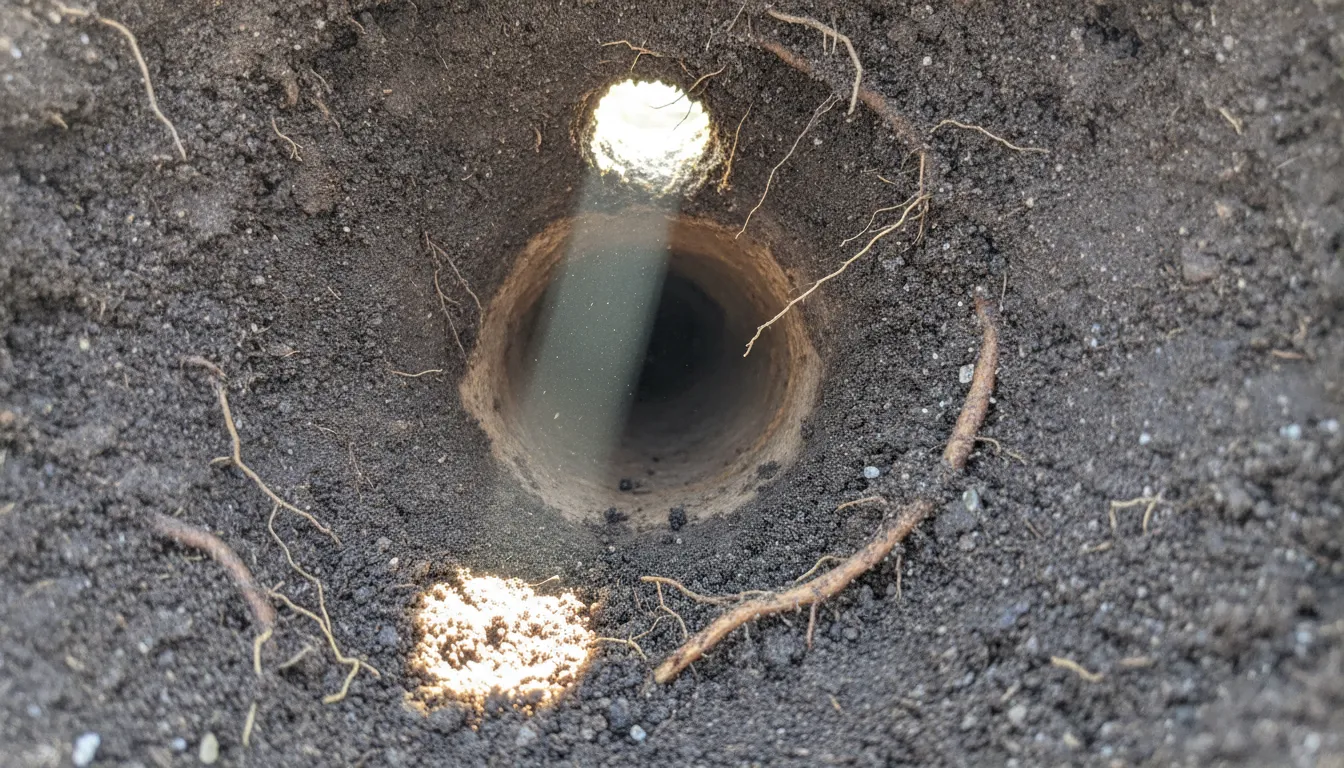
A fresh mound is not the tunnel a pocket gopher lives in. How do gophers choose a tunnel when the yard is full of plugged holes? They keep one main runway for daily travel and open short side chutes only when they need to dump dirt. The chute you can see is only the exit, while the runway you cannot see is the road the animal keeps using.
If the mounds keep coming back, start with the Cinch gopher trap sized to the runway you find, not to the mound on top.
That choice matters more than the mound count. A pocket gopher rarely wanders the whole network at random. It uses the smoother path that already connects food, the nest, and food storage. A trap set in the dirt chute waits on a tunnel the animal may not enter again. This guide shows how to tell those tunnels apart before you dig.
How Do Gophers Choose a Tunnel They Will Reuse?
Pocket gophers do not shop for a tunnel the way a person picks a garden path. They build a private burrow system, then reuse the parts that already work. University of California IPM describes a system that can cover 200 to 2,000 square feet. One animal usually lives there alone, except when a female is raising young or during breeding season.
Inside that system the gopher has a few jobs to keep doing. It needs a way to reach roots, a place to nest and store food, and a way to push loose soil out of the burrow. Those jobs do not share one tunnel. Feeding burrows usually sit 6 to 12 inches down and run about 2.5 to 3.5 inches wide. The nest and food chamber can sit much deeper, sometimes as far as 6 feet, depending on the soil.
The tunnel it chooses for daily travel is the one that already joins those rooms. That main burrow is packed smooth by repeated trips. Short, sloping laterals branch off it only when the gopher needs to push dirt to the surface. UC IPM notes that gophers create those laterals while they build or clean the main tunnel, then seal the opening with an earthen plug.
So the fresh crescent mound is a clue, not the destination. The plug sits off to one side of a horseshoe or half-circle of soil. The gopher used that chute today. It will choose the main runway again tomorrow. If you only open the plug, you are standing at the exit, not in the hallway the animal actually travels.
- Main runway: the packed path the gopher travels between food and nest.
- Feeding burrow: a shallower run, often 6 to 12 inches down, near roots.
- Lateral chute: a short slope used to dump soil, then plugged.
- Nest or storage: deeper rooms the gopher does not cross all day.
Gophers reuse the main runway and treat fresh mounds as temporary dirt exits.
Why a Fresh Mound Is Usually the Wrong Tunnel
The newest mound feels like the obvious place to work. The soil is loose, the plug is visible, and the damage is right there in the grass. That mound was made because the gopher was already somewhere else. It dug or cleaned a tunnel, then pushed the spoil up a side chute and closed the door behind it.
UC IPM says one gopher can create several mounds in a day. In a dry yard, that building shows up most in winter and spring, when soil is moist. In an irrigated lawn or garden, mounds can appear any time, because the digging stays easy. A row of new mounds does not mean a row of separate gophers. It often means one animal cleaning one system.
The plug is the giveaway. Gopher mounds are crescent or horseshoe shaped, with the plugged hole off to the side. Mole mounds are rounder, with the plug near the middle, and moles also leave raised surface ridges. If you are unsure which animal made the hole, compare the mound before you pick a product. A pocket gopher signs guide walks through soil shape, and what a vole is covers the surface runways voles leave in grass.
Opening every fresh plug teaches the wrong lesson. The chute is short and may already be backfilled with loose soil, so the gopher does not have to return to a finished exit. It chooses the tunnel that still leads to food. That is why a trap set in the mound often sits quiet while a new mound appears ten feet away.
A fresh mound marks where dirt came out, not where the gopher will walk next.
Main Runway, Lateral, and Feeding Burrow
Once you know the three tunnel types, the choice gets simpler. You are not guessing which hole looks busiest. You are asking which tunnel still connects the system.
| Tunnel | What it is for | What you usually see | Good place for a trap? |
|---|---|---|---|
| Lateral chute | Pushing soil out, then sealing the hole | Fresh crescent mound and a side plug | No. It is a short exit, not a daily path. |
| Main runway | Travel between food, nest, and storage | A level tunnel a short probe finds past the mound | Yes. This is the tunnel the gopher keeps using. |
| Feeding burrow | Reaching roots and pulling plants down | Often 6 to 12 inches deep near damaged plants | Sometimes, if it is open, packed, and active. |
| Nest or storage | Resting and keeping food | Much deeper, sometimes several feet down | No. Do not dig for rooms you cannot see. |
The main runway is usually the level tunnel you hit when you probe past the mound, not straight down through the plug. Laterals slope upward toward the lawn, while the runway tends to run flatter and the probe drops suddenly into the open tunnel. Feeding burrows stay in that 6 to 12 inch band because that is where many roots are. Deeper rooms are not useful targets. You will not place a trap six feet down, and the gopher does not cross that chamber every trip.
Width is the other clue. UC IPM puts typical burrows at about 2.5 to 3.5 inches across. A tunnel much smaller than that may be a side pocket or a different animal. A tunnel you cannot measure is not ready for a trap. Match the opening you find to a trap that sits snug in it. On the gopher trap page, Cinch sizes the set trap to the tunnel: about 1 7/8 to 2 1/4 inches, about 3 inches, or about 3 1/2 inches.
Choose the level main runway, measure it, and ignore the short dirt chute.
How to Find the Tunnel a Gopher Keeps Using
You do not need to excavate the yard to answer this. A long screwdriver or a slim soil probe is enough if you work from a fresh mound back toward the burrow and stop at the first level tunnel.
- Pick the freshest crescent mound, not an old crumbled one.
- Stand off to the plugged side and probe 8 to 12 inches out from the plug.
- Feel for a sudden give. That drop is usually the main runway.
- Open a small hole only wide enough to see both directions of that tunnel.
- Look for a round, packed opening about 2.5 to 3.5 inches wide.
- If you only find a short sloping chute, move farther from the mound and probe again.
- Mark the spot with a flag so you can check it without losing the hole.
Two open directions are the sign you want. A lateral often ends at the plug in one direction and meets the runway in the other, while the runway itself continues both ways. That is the tunnel the gopher will choose on its next trip, because both ends still lead somewhere useful in the burrow.
Check the soil, not just the shape. An active runway has smooth walls and looks used. A backfilled chute is loose and ends quickly. If the probe hits solid soil in every direction, that mound is finished. Move to a newer mound on the same cluster. The complete gopher control guide covers what to do after you have confirmed an active system. This step is only about finding the tunnel.
Do not flood the hole or leave it open all afternoon. Light and air tell the gopher the tunnel changed. It can plug a damaged section and choose another branch. Open the runway, look, and then either set a trap or close the hole.
Probe past the plug until you hit a level tunnel that runs both ways.
Related products


Weather-resistant construction for outdoor use
View productWhat Makes a Gopher Pick One Branch Over Another
Gophers are not choosing a tunnel for comfort or curiosity. They choose the branch that still solves a practical problem. Food, soil that is still easy to dig, and a door the gopher can close all matter.
Food pulls them toward irrigated beds. UC IPM notes that in dry ground, mound building is strongest when soil is moist. A watered lawn, a drip line, and a raised bed stay diggable after the rest of the yard hardens. The gopher will keep the branch that reaches those roots and abandon a dry fork that no longer pays. If plants are disappearing on one side of the yard, the active runway is likely headed there, not toward the oldest mounds.
They also choose closed, dark tunnels over open ones. Gophers seal openings with soil plugs because an open hole is a draft and a risk. If your probe hole stays open and a new plug appears in it, the animal is still using that branch and has noticed the change. If the hole stays open and no new soil shows up nearby, that branch may already be idle.
Territory narrows the choice further. You rarely have several adults sharing one system. A new mound far from the cluster can be a second gopher, or the same gopher extending a feeding run. Do not assume every mound is a new animal. Follow the fresh work back to a runway before you decide you need more than one setup.
Season does not turn the rule off. Gophers do not hibernate, and they can work day or night. In snow, they may even burrow in the snowpack and leave earthen cores when it melts. The tunnel they choose is still the one that connects food and cover. A mole tunnel depth guide is a different animal and a different shape. Do not use mole ridges to pick a gopher branch.
The gopher keeps the branch that still leads to food and can be sealed.
Where the Trap Belongs After You Choose the Tunnel
Finding the runway is the decision that matters. Setting the trap is the next job, and it belongs in that runway, not in the mound. Cinch traps are built to sit inside the tunnel the animal already travels. The set trap should fit snug against the packed walls, because a loose trap in a wide hole lets the gopher plug around it and choose a side path.
Use the tunnel you measured. A single Cinch gopher trap is $24.99 and includes the trap, a flag, and a brochure. The gopher kit is $54.99 and includes three traps and three flags, which helps when one system has two open directions. The deluxe gopher kit is $64.99 and adds gloves, a tunnel tool, and maintenance spray. Pick the size that matches the opening: about 1 7/8 to 2 1/4 inches, about 3 inches, or about 3 1/2 inches. Active and former military members can use a 10 percent discount with a GOVX ID.
Place the trap in the main runway, cover the opening so light stays out, and check it often. UC IPM recommends trapping in active burrows, often with two traps facing opposite directions, and continuing until new mounds stop. Exact setting steps live in the professional gopher trap setting tips and on the how to set Cinch traps page. If a set looks sprung or plugged and the mound line continues, the gopher trap troubleshooting guide is the place to sort out the miss.
Shipping on accessory items is a flat rate when you buy a trap. Do not describe that shipping as free, because the live offer is a flat rate, and the traps themselves are galvanized steel, made in Oregon, and reusable. The lifetime warranty does not cover rust or corrosion from poor cleaning, so wipe the trap down after use.
Skip the methods that do not change which tunnel the gopher uses. UC IPM reports that repellents, gopher purge, garlic, vibrating stakes, and ultrasonic gadgets have not held up as yard protection. Gas cartridges also fail because a gopher can seal a burrow quickly. Those products do not make the animal choose a convenient hole. A trap in the runway does.
Set the snug trap in the measured main runway, then close the light out.
Mistakes That Send You Down the Wrong Tunnel
Most misses come from treating every hole as equal. The gopher is not doing that, because it has already picked the branch it will travel and the other openings are leftovers from earlier digging.
- Setting in the plug. The plug is the closed end of a dirt chute.
- Digging a wide pit. A huge opening is easy for the gopher to pack shut.
- Trusting an old mound. Crumbled soil can be a finished exit from weeks ago.
- Using a mole ridge as a gopher map. Moles leave surface ridges. Gophers leave side-plugged crescents.
- Leaving the hole open to "see who comes." Light often makes the gopher plug that branch and switch.
- Buying a size for the mound, not the tunnel. Measure the runway you will actually use.
If you are comparing this with mole work, keep the animals separate. Moles travel shallow feeding ridges and deeper runs, which is why active mole tunnel identification is its own guide. A gopher system is a plugged burrow, not a raised ridge. Using one map for both animals is how traps end up in empty soil.
Give a good runway a fair check before you move. New mounds elsewhere in the same cluster can still be the same gopher pushing dirt out a different chute. Move only when the runway you opened shows no fresh plugs and the probe no longer drops into an open tunnel.
The wrong tunnel is usually the visible plug, the old mound, or a mole ridge.
Read the Yard After You Pick a Tunnel
The day after you open a runway, the yard gives you a clear answer. A new plug in your hole means the gopher chose that branch again and closed the change, while a fresh mound a few feet away means it pushed dirt from the same system. No new soil, and a probe that no longer drops, means that branch is done.
Keep notes simple. Flag the runway, note the width, and note whether both directions were open. You do not need a map of all 2,000 square feet. You need the one tunnel the animal is still willing to enter. When that tunnel goes quiet and mounds stop, the choice you made was the right one.
If mounds continue after a careful set, go back to the probe before you add products. Find the next level tunnel that runs both ways. Then use the setting guide rather than guessing from the surface. For a second look at species and legal questions around traps, the mole and gopher FAQ is the short version.
A new plug in your hole means the gopher chose that same tunnel again.
Frequently Asked Questions
How do gophers choose a tunnel when there are many mounds?
They do not pick a mound. They keep using the main runway that joins food, nest, and storage. The mounds are the ends of short laterals used to dump soil. Probe past the freshest plug until you hit the level tunnel.
Is the tunnel under the fresh mound the active one?
Usually it is only the exit chute. The active travel tunnel is the flatter burrow that continues in both directions a short distance from the plug. If your hole ends in loose fill, you are still in the lateral.
How deep is the tunnel a gopher actually uses?
Feeding burrows are usually 6 to 12 inches below ground and about 2.5 to 3.5 inches wide, according to UC IPM. Nest and storage rooms can be much deeper. Trap the shallow travel tunnel, not the deep room.
Will a gopher come back to a tunnel I opened?
It may, if that branch still leads to food and you close the light out. An open, bright hole is a reason to plug the branch and switch. Cover the opening after you look or set a trap.
Can I tell a gopher tunnel from a mole tunnel by the mound?
Yes, often. Gopher mounds are crescent or horseshoe shaped with a plug off to the side. Mole mounds are rounder with a more central plug, and moles also push up surface ridges. Voles leave narrow surface paths in the grass.
Choose the Runway, Then Set the Trap
How do gophers choose a tunnel? They stay on the main runway that still leads to food and can be sealed, and they use fresh laterals only as short dirt exits. Find that level tunnel, measure the opening, and put the trap there.
When you are ready, order the Cinch gopher trap in the size that fits the runway, or use the contact page if you want help matching a kit.