

Fresh, half-circle mounds with a plugged opening off to one side are your starting point. They indicate where a gopher is actively working, even though the animal itself spends almost all its time underground. Learning how to set a gopher trap at that active tunnel is only the first step. The result depends on what happens before the trap goes in: finding the tunnel. Opening it cleanly, fitting the trap without damaging the run, and matching the set to the soil.
To set a gopher trap effectively, locate a fresh active tunnel. Prepare the opening so the trap sits securely underground, and conceal the hole so light does not enter. Professional sets may use paired traps facing each other, while soil conditions can determine placement and sensitivity.
Shop Cinch gopher traps for a mechanical, no-chemical approach to tunnel control.
A careful set starts with observation rather than guesswork. Before choosing a configuration, inspect the mound, confirm the tunnel direction, and consider how loose, compacted, or clay-heavy soil will affect the opening. The same field habits that help a trap sit correctly also make concealment more reliable. So the next step is checking the tunnel like a professional before setting anything.
What Professional Trappers Check Before They Set a Gopher Trap
Experienced trappers do not start by opening a hole at the first mound they see. They first confirm the animal, locate the active runway, and prepare a clean set. That inspection makes the set precise instead of a guess made in the soil.
Start with the mound pattern. UC IPM describes gopher mounds as loose dirt shaped like half circles, with a plugged opening set off to one side. Fresh mounds are the most reliable sign that a gopher is still active in the area. UC IPM's pocket gopher guide also notes that gophers spend almost all their time underground, so a lack of sightings does not mean the tunnel is inactive.
Confirm the target before disturbing the soil
Moles are a common source of misidentification. Their mounds are circular and have a center plug, while gopher mounds generally have the plug off to one side. Ground squirrel holes are open and do not have a mound. This distinction matters because a well-set gopher trap cannot solve the wrong animal problem.
Once the mound looks right, probe carefully around the fresh soil to find the underground passage. The trap belongs inside the burrow, not directly beneath the mound by default. Look for the main runway and note whether the tunnel runs left to right, toward a fence line, or along a bed or lawn edge. Tunnel direction helps you position the trap so it sits naturally in the route instead of obstructing a dead-end pocket.
Prepare the set, not just the trap
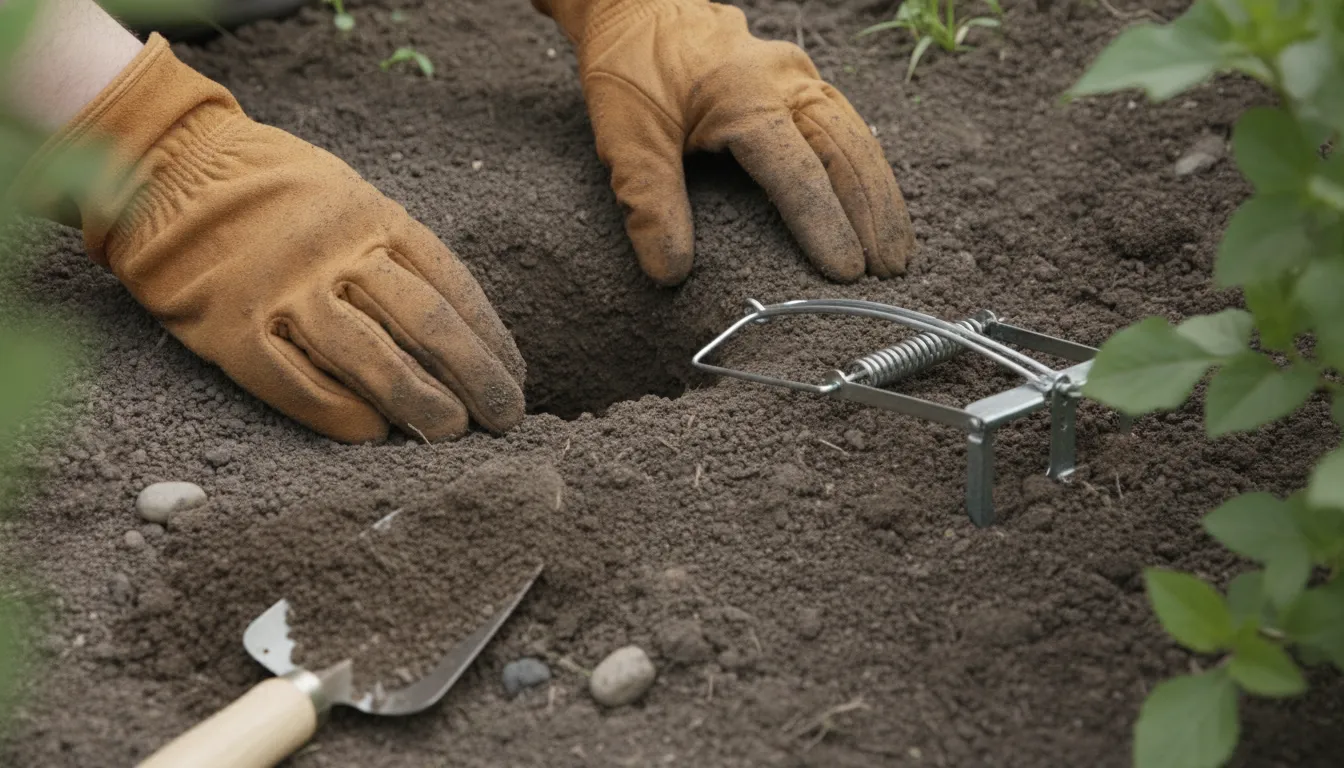
Have the trap, probe, hand trowel, gloves, and suitable material for covering the opening ready before you expose the runway. Keep the tunnel opening as narrow and tidy as practical. Loose dirt should not fall onto the trigger or prevent the trap from sitting squarely. Avoid turning the runway into a large, bright cavity. UC IPM recommends covering the opening so light does not enter, since gophers avoid exposed light in their burrows.
Inspect the soil as you work. Dry, collapsing soil may need a cleaner cut, while firm soil can hold the runway shape more reliably. The goal is a stable, concealed placement with the trap aligned to the active passage. Professional tunnel preparation is key to trap success because the animal encounters the set in the path it is already using.
A professional set begins with correct identification, a fresh mound, a confirmed runway, and a prepared, concealed tunnel, not a trap placed by appearance alone.
How to Set a Gopher Trap in an Active Tunnel
A reliable set begins before the trap enters the ground. The objective is not to place a trap near a mound and hope the gopher finds it. It is to identify a working runway, prepare a clean passage, and make the trap feel like part of the existing tunnel. Fresh soil is your best starting point. UC IPM identifies fresh mounds as a sign of an active gopher and recommends placing traps underground inside the burrow. See its guidance on pocket gopher identification and trapping before you dig.
Use the following sequence when you need a professional-quality set rather than a quick surface placement:
- Locate activity, then trace the runway. Start at a fresh mound and probe carefully around the plugged area until you find the tunnel. Do not assume the mound itself marks the best setting point. Follow the passage far enough to determine its direction and whether the soil feels recently worked. If several fresh mounds line up, prioritize the main runway instead of treating every mound as a separate set.
- Expose only enough tunnel to work accurately. Open the runway from above with controlled movements. Clear loose soil so you can see the passage, but avoid collapsing or widening it unnecessarily. The opening should give you room to position the trap and inspect the trigger without turning the tunnel into a large, unnatural cavity. Do not invent a fixed depth or opening size; the correct excavation depends on the trap and the surrounding soil.
- Prepare the floor and sidewalls. Remove clods, roots, stones, and loose debris that could obstruct the trap or interfere with the trigger. Firm unstable soil where needed, while preserving the tunnel's natural direction. The trap should sit level and remain stable when the cover is replaced. Tunnel preparation is a central part of success because a poorly supported trap can shift, bind, or leave an avoidable gap.
- Orient the trap with the runway. Place the trap so a gopher traveling through the active passage encounters the working end naturally. For a longer or uncertain run, use a paired arrangement with traps facing each other. UC IPM specifically recommends pairs facing opposite directions, which accounts for movement from either side. Keep the mechanism aligned with the passage rather than forcing the trap diagonally across it.
- Check the trigger before concealing the set. Confirm that the trap is fully armed according to the manufacturer's instructions and that the trigger moves freely. Look for soil touching the mechanism, a bent component, or tension created by an uneven floor. Make the final adjustment before covering the opening. Never place fingers near a set mechanism; use the tool or handling points provided for that trap.
- Restore darkness and monitor consistently. Replace soil or a suitable cover so daylight does not enter the runway. UC IPM advises covering the opening because gophers avoid light. Keep the cover stable but accessible for inspection. Check the trap regularly and reset it as necessary. If fresh soil appears elsewhere, reassess the active runway rather than repeatedly resetting a trap in a disturbed or inactive section.
Professional judgment matters most in the transitions between these steps. A fresh mound gets you to the tunnel, but a clean floor, stable sidewalls, correct orientation, and a dark opening determine whether the set behaves naturally. Soil conditions can also change how firmly the trap sits and how sensitively the trigger should be adjusted. So inspect the completed set instead of relying on a memorized placement formula.
The best way to set a gopher trap is to match a properly prepared trap to a confirmed active runway. Verify the trigger, restore darkness, and continue checking and resetting the set as conditions change.
Related products


Upgraded components built for frequent, intensive use by professionals and landowners.
View productHow Should You Prepare and Conceal the Tunnel Opening?
After placing the trap in the runway, the opening deserves as much attention as the trap itself. A rough excavation can leave loose soil on the trigger, shift the trap out of position, or create a gap that changes how the gopher approaches. Professional tunnel preparation is key to trap success because the goal is to restore a believable passage, not simply cover a hole.
Start by removing only enough soil to expose the runway and create a clean working space. Keep the tunnel walls as intact as possible. A stable wall gives the trap firm contact and helps prevent the mechanism from rocking when soil settles. Brush loose dirt away from the trigger, jaws, and other moving parts before you begin closing the opening. Dirt that falls directly onto the mechanism can interfere with a clean set.
Once the trap is positioned, use the excavated soil to close the opening without packing it tightly against the trap. Build the cover gradually, supporting weak edges and leaving the runway itself open around the trap. Avoid pushing a heavy clod into the tunnel. The cover should be stable enough to hold its shape, yet natural enough that the gopher encounters a passage rather than a sudden soil blockage.
Blocking light is essential. Gophers spend almost all their time underground, and they avoid exposed light in the burrow. UC IPM specifically advises covering the hole so light does not enter: UC IPM's pocket gopher guidance. Use a small board, a flat piece of material, or carefully placed soil to shade the opening while keeping the cover from touching the trap. The best cover prevents a bright opening without collapsing the tunnel.
Preserve the runway on both sides of the set. Do not widen it unnecessarily, scrape away more wall than needed, or leave a ridge that forces the gopher to change direction. Check that the trap remains aligned with the travel path and that no loose soil is resting where it can foul the mechanism. Mark the location discreetly so you can check the set without disturbing the surrounding ground.
A clean excavation, stable trap contact, light-blocking cover, and undisturbed runway give the set its best chance to function as intended.
Single, Paired, or Multiple Traps: Which Set Fits the Run?
Trap quantity should follow what you can confirm about the active tunnel, not a blanket rule. Fresh soil and a clearly defined run give you a better basis for choosing a single set, a paired set, or several sets. Since gophers spend almost all their time underground, the useful decision happens inside the burrow, where the trap can intercept movement.
Professionals also separate configuration from trap quality. A well-positioned trap in the wrong tunnel is still a poor set. Prepare the run carefully, keep the mechanism aligned with the tunnel, and avoid disturbing more soil than necessary. The goal is a stable, concealed setup that matches the evidence in front of you.
| Configuration | When it may fit | Field considerations |
|---|---|---|
| Single trap | One active tunnel direction is clear, or the available opening gives you a straightforward place to intercept movement. | Use careful alignment and conceal the opening. Recheck the set if loose soil shifts or the tunnel condition changes. |
| Paired traps | The tunnel has two possible approaches, or you want to cover movement from either direction in the same run. | Place the traps facing each other. This is the paired arrangement recommended by UC IPM for pocket gopher tunnels. |
| Multiple traps | A longer or more complex active run has several confirmed sections that can be set without guesswork. | Use separate, deliberate placements. Do not add traps simply to increase the count, and inspect each location independently. |
Paired traps are especially useful when you cannot confidently identify which way the gopher will approach. UC IPM specifically recommends placing two traps facing each other in the tunnel, rather than relying on a single direction of travel. See the UC IPM pocket gopher guidance for the source recommendation. Both traps still need room to function, and the tunnel should be closed so daylight does not enter.
Multiple configurations require more judgment. One active run may justify more than one set when its branches or openings are clearly connected. But each placement should be tied to an observation, such as fresh activity or a usable tunnel section. Avoid claiming that more traps guarantee faster control. Capture results depend on tunnel choice, preparation, soil conditions, and whether the mechanism remains properly set.
For a practical walkthrough of how to set a gopher trap, start with the simplest configuration that matches the tunnel. Move to a paired or multiple arrangement only when the run gives you a sound reason to expand the setup. Choose a single trap for a clear interception point, paired traps for two-way tunnel coverage. And multiple traps only when several active sections can be identified and set carefully.
How Do Soil Conditions Change Trap Setup?
Soil is part of the set, not just the material surrounding it. A tunnel that is easy to open and shape in one yard may collapse, bind, or leave too much room around a trap in another. Since soil conditions directly affect trap placement and sensitivity. Take a moment to read the ground before deciding how much to excavate or how firmly to seat the trap.
Sandy soil
Loose, sandy soil often falls back into the tunnel as you work. Make the opening only as large as necessary to reach the runway, then clear loose grains from the trap's working area. Avoid piling freshly disturbed sand directly against moving parts. If the tunnel walls will not hold their shape, use the surrounding soil to support the set rather than forcing the trap into a shifting cavity. The goal is a stable, unobstructed path through the active tunnel.
Clay and damp soil
Clay can hold a clean tunnel shape, but damp clay may smear onto the trap or close the passage when compressed. Work carefully and preserve the natural direction of the runway. If the soil is sticky, remove clumps that could interfere with the trap's movement, but do not overwork the tunnel into a polished, unnatural channel. Wet ground also deserves a closer look after installation. Rain or irrigation can change the opening and add weight to loose material, so inspect the set and reset it if the tunnel has slumped.
Rocky or compacted ground
Rocks and hard-packed soil make tunnel preparation slower and can tempt you to place a trap in a convenient hole instead of the actual runway. Use field signs, especially fresh mounds, to trace the active route before digging. Remove only the obstruction needed to expose and prepare the tunnel. A trap that is tilted, wedged against a stone, or surrounded by a cramped pocket may not respond as intended. If the ground will not allow a clean, stable set at that location, follow the tunnel to a more workable section.
Across all soil types, check the fit from the gopher's point of view. The trap should sit in the tunnel without an accidental gap that lets the animal bypass it, while the moving parts remain free of soil and roots. Keep the excavation controlled, preserve the tunnel's route, and replace or arrange loose soil so the opening does not invite light into the burrow. Gophers spend almost all their time underground, so a properly prepared tunnel is where the set does its work. Cinch's galvanized mechanical traps are designed for this underground application, but no trap can compensate for a poorly located or unstable set.
Match the preparation to the ground: stabilize loose soil, clear sticky or compacted material from the working area. And seat the trap squarely in an active tunnel without forcing it against rocks or debris.
What Should You Do When a Professional Set Does Not Catch?
A sprung trap with no catch does not always mean the trap failed. Start by treating the set as a field diagnosis. Check three things before resetting. Is the tunnel active? Does the trap fit the runway? Can the soil support the mechanism? Professional tunnel preparation is key to trap success, so change one condition at a time instead of moving everything at once.
1. Confirm that the tunnel is still active
Go back to the surface signs first. Fresh mounds are the most reliable indication that a gopher is actively using the area. If the mound is old, weathered, or undisturbed, the tunnel may no longer be the best location. Check nearby mounds and look for a newer push of loose soil. Also make sure the animal is a gopher rather than a mole or ground squirrel. UC IPM notes that mole mounds are circular with a center plug, while ground squirrel holes are open and lack a mound. Gophers spend almost all their time underground, so surface activity is a better guide than waiting to see the animal.
2. Inspect the runway and trap fit
Open the set carefully and look at the tunnel floor and walls. The trap should sit in the actual runway, not in a shallow side pocket or loose excavation that the gopher can avoid. Remove only enough loose dirt to create a clean fit. Excess soil beneath or around the trigger can interfere with sensitivity. While a trap that rocks or sits at an angle may not present a natural path through the tunnel. Avoid relying on bait as a correction. Gopher traps do not require food-based baits to be effective, so location and fit deserve attention first.
3. Remove light and loose dirt
Look for daylight entering the opening, gaps around the cover, or fresh dirt that has fallen across the trap. Gophers avoid light, and UC IPM recommends covering the opening so light does not enter. Keep the cover secure without pressing soil onto the mechanism. If the gopher has pushed dirt into the set, clear the runway and reset it rather than burying the trap deeper.
4. Reassess soil and reset nearby
Soil conditions directly affect trap placement and sensitivity. Sandy soil may collapse into the runway, while clay or compacted soil can make a clean, natural opening difficult to form. Adjust the set so the trap rests steadily and the passage remains open. If the evidence still points to activity but the location produces no result, reset at a better-defined section of the same tunnel run. For additional troubleshooting guidance, review the Cinch mole and gopher FAQs.
When a set does not catch, verify fresh activity, tunnel fit, concealment, and soil conditions before blaming the trap. A careful reset in the right runway is usually the most useful next move.
Why Professionals Choose a Reusable Mechanical Trap
Repeat field work rewards a trap that fits the same disciplined process every time. Professionals identify an active tunnel, prepare the opening, place the trap underground, and check the set as part of a routine. A reusable mechanical trap supports that workflow without adding bait handling or chemical application to the job.
Cinch Traps use mechanical operation and do not require chemicals. That makes the set straightforward: prepare the tunnel carefully, position the trap, and retrieve it after the set has been checked. The trap itself does not replace good field judgment. As Cinch's guidance emphasizes, tunnel preparation is key to trap success. A poorly located or loosely prepared opening can undermine an otherwise sound set.
Consistency matters in repeat work
Landscapers, farmers, and pest-control professionals may return to the same property more than once. A reusable trap gives them a familiar tool and a repeatable set rather than a disposable response. They can assess fresh activity, adjust the opening to the tunnel, and reset the equipment when the work calls for another placement. That consistency is especially useful when soil conditions change the way a trap should be placed or how sensitively it should be set.
Mechanical operation also keeps the task focused on the burrow. Gopher traps belong underground inside the gopher tunnel, so preparation and concealment remain central. The goal is not to add a complicated lure or scent routine. It is to make the set fit the active runway and preserve the conditions that encourage a gopher to travel through it.
Built for a professional field standard
Cinch Traps are positioned as professional-grade, American-made mechanical traps for mole and gopher control. Operators who want a durable tool can use a familiar process from visit to visit. The company's history and approach are explained in the Cinch Traps story and manufacturing background.
When the set is prepared correctly, the value of a reusable trap is practical: one familiar mechanical method can support inspection, resetting, and ongoing tunnel work. For the available trap options, shop Cinch gopher traps.
Shop Cinch Traps for a reusable, American-made mechanical option built around careful tunnel preparation and repeatable field work.
Reusable mechanical traps give professionals a no-chemical, repeatable way to manage tunnel sets while keeping preparation and placement at the center of the work.
Frequently Asked Questions About Gopher Trap Setting
How do you trap gophers effectively?
Start at a fresh mound, then locate the active tunnel beneath it. Open the tunnel carefully, prepare a stable surface, and place the trap inside the run. A clean fit matters: the trap should sit securely without loose soil interfering with its trigger. After setting it, cover the opening so light does not enter.
Why aren't my gopher traps working?
Recheck the activity and the set itself. An old mound may no longer mark an active tunnel. Loose soil, an unstable placement, or an uncovered opening can also reduce the chance of a proper set. Fresh mound activity, careful tunnel preparation, and soil-appropriate adjustment are the first things to inspect.
How many traps do I need for gopher control?
The number depends on the tunnel run and the set configuration. One trap may suit a clearly defined location, while paired traps facing each other can cover movement from either direction. Multiple trap configurations may be useful when the run has more than one practical access point.
Is trapping pocket gophers effective?
Trapping is a direct mechanical control method that works inside the animal's underground tunnel. It does not require chemicals, but the result depends on identifying an active run. Preparing the tunnel correctly, fitting the trap securely, and adapting the set to the soil.
Successful gopher trapping comes down to an active tunnel, a stable set, a concealed opening, and a configuration that matches the run and soil.
Good gopher trapping is repeatable: confirm activity, prepare the runway, fit the trap, block light, and check the set. The right equipment makes that process easier to apply across lawns, gardens, farms, and managed properties.
Shop Cinch gopher traps for your next professional-quality set.