

If you have seen fresh ridges or mounds in your yard, you may wonder: do moles have eyes, and can they see where they are going? Yes. Moles have eyes, but their vision is limited compared with that of many aboveground animals. They navigate a world of soil and tunnels with help from other senses, especially touch. Understanding that difference explains why a mole can move through a run without needing to see it clearly—and why activity in the right tunnel matters more than what is visible on the lawn.
Ask Cinch Traps about finding active mole runs
Do moles have eyes, or are they blind?
Moles do have eyes. The idea that they are completely blind is a common misconception. Their eyes are very small and may be difficult to notice beneath their fur. In some species, the eyes are even covered by skin. The University of Aberdeen describes mole eyesight as very limited, with some moles being seriously short-sighted. The important distinction is that having eyes does not mean relying on vision as people do.
Researchers and wildlife educators describe mole eyes as poorly developed or hard to see, not simply absent. The Natural History Museum notes that star-nosed moles have small eyes often hidden in their fur. The National Wildlife Federation likewise describes mole eyes as poorly developed and highlights touch as a key sense. These sources address different mole species and descriptions, so it is safest to say that mole vision is limited and varies rather than assume every mole sees the same way.
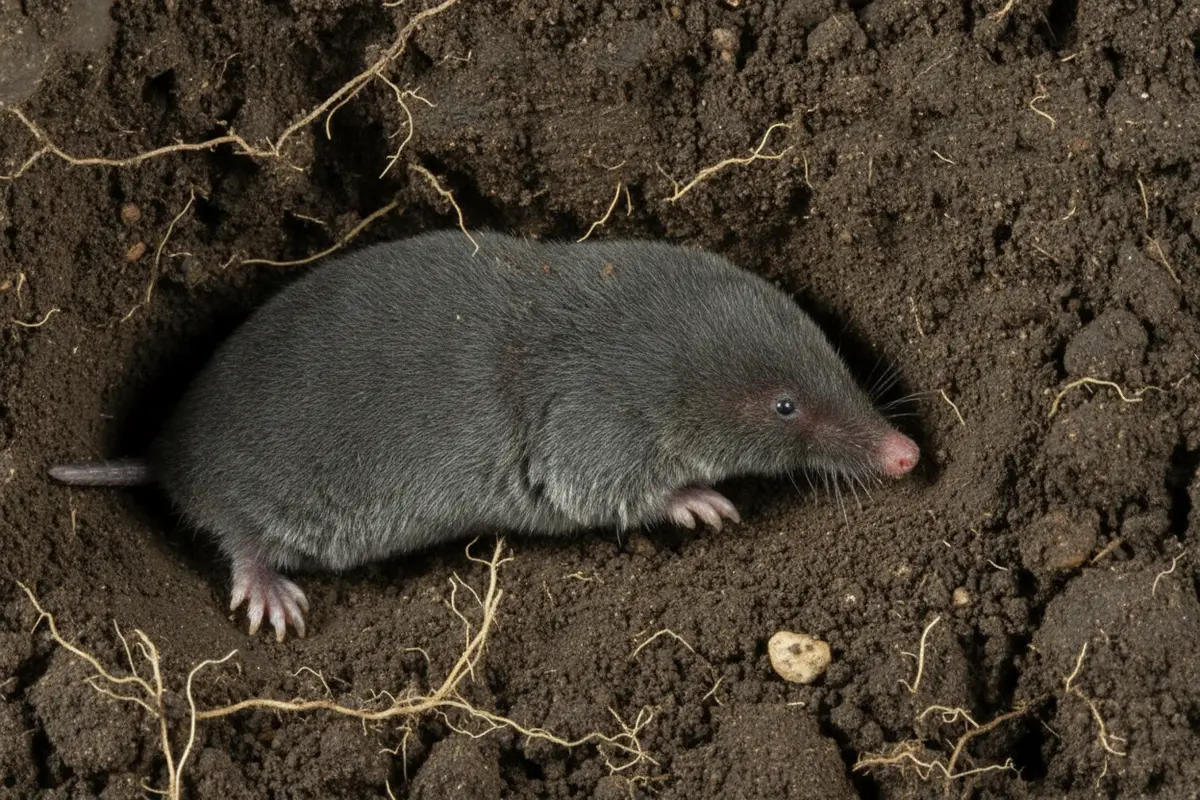
That difference matters when interpreting signs in your yard. A mole does not need sharp eyesight to follow a familiar tunnel or detect changes nearby. And a visible surface ridge is not a window into everything happening underground. It is a clue that a tunnel may be close, not proof that a mole is currently traveling through that exact section.
For homeowners, the useful takeaway is practical: do not expect a mole to avoid an obstacle simply because you can see it, and do not assume a tunnel is inactive just because it looks dark or hidden. The animal's movement is tied to its underground routes and sensory cues. For background on the animal itself, see our guide to what moles eat and how they affect lawns.
Moles have eyes, but limited eyesight; calling them blind misses how they use other senses in an underground habitat.
How does a mole find its way underground?
Underground, a mole moves through a close, enclosed environment. Its body is in contact with soil and tunnel surfaces, and touch helps it gather information as it travels. Small eyes and reduced visual ability do not prevent the animal from navigating a system it uses. Moles can move through dark tunnels because clear sight is not the only way to orient, detect surroundings, or follow a route.
The Natural History Museum's overview of star-nosed moles explains that their eyes are small and often concealed by fur, while the National Wildlife Federation notes that moles make up for poor sight with touch. The University of Aberdeen also discusses limited mole eyesight. Together, these sources support a measured point: sight is not a mole's strongest tool, and other sensory information helps it function in the dark. They do not mean every detail of mole navigation is identical across species.
For a yard owner, it helps to picture a mole using its tunnel as a protected travel corridor. The animal can encounter tunnel walls and soil as it moves, while the route reduces the need to cross open ground. Freshly disturbed soil can reveal where digging has happened, but the visible sign alone does not tell you whether the animal still uses that segment. A mole may extend a tunnel, revisit a route, or shift activity elsewhere.
- Small eyes: Moles have eyes, but they are often difficult to see and their vision is limited.
- Touch: Contact with the surrounding tunnel and soil supplies important information.
- Tunnel clues: Surface ridges and disturbed soil can help you locate possible routes, but they need checking.
It is also useful to keep mole biology separate from assumptions about gophers. Moles and gophers are different animals and can leave different patterns of damage. Do not choose a control method based on a vague idea that any underground animal behaves alike. If you are unsure what is creating the damage, start with a reliable identification guide such as Cinch Traps' beginner guide, then follow the advice for the animal you actually have.
Moles use more than vision to travel, so fresh tunnel activity—not eyesight myths—should guide your next observation.
What can mole eyesight tell you about lawn damage?
Limited vision helps explain why the animal's world differs from yours, but it does not diagnose the cause of every lawn mark. Raised, winding ridges may indicate shallow mole activity, while other underground animals can produce different signs. Soil type, moisture, landscape features, and the animal's current activity can all affect what you see. Avoid deciding solely from one mound or a single line of disturbed grass.
A mole's vision also does not make surface damage random in a way that is impossible to interpret. The soil disturbance can point to a route or feeding area, but a single sign is only a starting clue. Watch the yard over time. Note which ridges are new, whether a section changes after you flatten it, and where new soil appears. This simple observation helps separate old damage from recent movement.
Use a calm, repeatable check rather than assuming every visible run is active:
- Map the signs. Mark the sections with fresh ridges or newly disturbed soil. Avoid treating old, flattened damage as current activity.
- Choose a short section to monitor. Gently press down a small part of a suspected surface run, taking care not to damage plants or irrigation.
- Check it again later. If the section is raised again, that is a useful sign of recent travel. If nothing changes, inspect another area rather than forcing a conclusion.
- Confirm the animal. Compare the pattern with a mole-specific guide and check for signs of gophers or other causes before selecting a trap.
This is observation, not a promise that every mole will reopen a pressed section on a fixed schedule. The goal is to base the next step on current evidence. The difference between moles and gophers matters because their habits and the appropriate trap setup are not interchangeable. Our article on mole control methods explains how trapping fits alongside other approaches.
Use fresh, repeatable signs to identify a likely active route; a mole's small eyes do not tell you whether a particular lawn ridge is in use.
Why does an active tunnel matter more than a mole's eyesight?
When a mole trap is part of your plan, placement in a tunnel the animal uses is central. The animal travels underground through runs; a trap placed in an unused passage cannot intercept that movement. This is why observing activity is more useful than speculating about what a mole can see. The question is not whether the mole can spot a trap from across the lawn. It is whether the trap is set correctly in an active route the mole is likely to travel.
Begin by identifying a suitable run. Look for a straight section that is accessible and appears recently used. A shallow ridge may be a surface feeding route, while more established tunnels can be deeper. Avoid assuming that every raised line is suitable for the same trap. Once you have selected a promising section, open only enough of the tunnel to place the trap according to its instructions, then restore the surrounding soil so the route is not left unnecessarily exposed.
Do not set equipment where children, pets, or non-target animals could reach it. Follow the product instructions and local requirements, and check the set-up as directed. If the site has irrigation lines, buried utilities, or delicate plantings, account for those before digging. Careful placement protects the yard and helps you avoid turning a small control job into a larger repair.
The basic logic is straightforward: identify the pest, find a likely active run, and place the correct trap where the animal travels. Cinch provides instructions on how its traps work; review them before setup rather than improvising. For more detailed placement guidance, use the step-by-step mole trap setting guide.
| What you observe | What it may suggest | Practical next step |
|---|---|---|
| Newly raised or disturbed soil | Recent digging, but not necessarily an active run at that exact spot | Mark it and monitor a short section for renewed disturbance |
| A pressed section rises again | Possible recent travel through that section | Confirm the pest and consider whether the run is suitable for placement |
| No change after monitoring | The section may be inactive, or activity may be elsewhere | Check another fresh sign instead of setting blindly |
| Damage pattern does not fit a mole | Another animal, including a gopher, may be involved | Identify the animal before choosing a trap or method |
Correct identification and active-run placement are more actionable than guessing what a mole sees while underground.
What does limited vision mean when choosing a mole control method?
Limited eyesight does not make a mole easy to control by default. It also does not prove that any one product or method will work in every yard. Your choice should reflect the animal, the damage, the location of current activity, and how you want to manage the problem. Mechanical trapping is one option for people seeking a direct method; repellents and other approaches work differently and should be evaluated on their own instructions and fit.
A mechanical trap is intended to intercept an animal moving through a route, rather than rely on the animal seeing and avoiding a surface device. That makes tunnel identification and placement important. A trap positioned in an inactive passage may not produce a result, regardless of its design. Likewise, a product intended for a different animal is not the right choice simply because both pests live underground.
Cinch Traps makes professional-grade in-tunnel traps in Oregon and has been a family-owned company for four generations. Its products are designed for use in a tunnel, and the company emphasizes durability and a lifetime warranty. Those product attributes are useful context, but they are not a guarantee that a trap will catch an animal on a particular timeline. Results depend on correctly identifying the pest, locating an active route, and following setup instructions.
To compare options without overcomplicating the decision, ask:
- Do the signs point to a mole, rather than a gopher or another cause?
- Can I identify a route that shows recent activity?
- Does the product match the animal and the tunnel where I plan to use it?
- Can I place and monitor it safely while following the product instructions?
If the answer to the first two questions is unclear, pause before buying. For a mole-specific product, see the Cinch mole trap and the full Cinch trap and kit selection. The how-it-works overview can help you understand the basic method before choosing equipment.
Explore the mole trap and review its setup instructions
Choose a control method based on the animal and confirmed activity, not on the mistaken belief that moles are blind.
How can you avoid common mistakes when responding to mole activity?
Most avoidable missteps begin with a guess: assuming an animal from one mound, setting in the first tunnel you find, or expecting eyesight to explain every movement. A more dependable plan is to slow down enough to confirm the pest and current activity, then use the method according to its instructions.
- Do not call every underground sign a mole sign. Compare the damage pattern and look for species-specific clues before selecting a mole product.
- Do not treat old ridges as proof of current travel. Soil may remain disturbed after the animal has moved on. Monitor new signs.
- Do not assume a mole will avoid an object because it can see it. Its vision is limited, but the outcome still depends on correct placement and movement through that route.
- Do not change setup randomly after a short wait. Check the instructions and the location first. If the route appears inactive, reassess rather than making repeated adjustments in the same place.
- Do not overlook safety. Keep traps inaccessible to children and pets, and consider buried utilities and irrigation before opening a tunnel.
When a first attempt does not work, review the sequence. Was the pest identified correctly? Was the chosen tunnel active? Was the trap appropriate to the species and placed as directed? Did the setting leave the tunnel in a condition the animal would travel through? A clear review is more useful than attributing failure to a mole's ability to see or not see.
For stepwise guidance, read the gopher trapping guide only if you have confirmed gopher activity; it is not a substitute for mole instructions. For moles, use the product and setup resources above. If you are still uncertain, contact Cinch Traps with your question before choosing a setup.
Confirm the animal, verify activity, follow the matching instructions, and treat safety as part of the plan.
Frequently asked questions about mole eyes and movement
Are moles completely blind?
No. Moles have eyes, though they are small and their vision is limited. Some species have eyes that are difficult to see beneath fur or covered by skin. The degree of vision can vary, so “blind” is an oversimplification.
Can a mole see in the dark?
A mole's limited vision is not the same as having no visual ability, but moles do not depend on clear sight to move through underground tunnels. Touch and information from the surrounding environment are important in their subterranean habitat.
Why are mole eyes so small?
Moles are adapted to spend much of their time underground, where vision is less useful than it is in open daylight. Their eyes are small and often hard to notice. The sources cited above describe limited vision and the importance of touch, rather than supporting a claim that every mole species has identical eyesight.
Does limited eyesight mean moles will not notice a trap?
Not necessarily. Limited sight does not mean a mole cannot detect changes through other senses, and it does not guarantee a trap will succeed. Correct pest identification, active-tunnel placement, and following the trap instructions matter.
Where can I learn more about mole tunnels and traps?
Start with the Cinch how-it-works information and the mole trap setup guide. Make sure you are dealing with a mole before using a mole-specific product.
Moles are not sightless, but their limited vision makes their underground route and other senses more relevant to how they move.
Understand the animal, then focus on its active route
Moles have small eyes and limited vision, yet they navigate underground by relying on more than sight. For a yard owner, the practical response is to identify the pest, watch for fresh activity, and place any trap according to its instructions in a suitable active run. Cinch Traps has made in-tunnel traps in Oregon since 1909; explore the product guidance and choose a solution that fits the animal in your yard.
See mole traps and kits from Cinch Traps
Know what is moving through your yard before you choose how to respond.
For safe, informed control, use current signs and species-specific guidance rather than relying on the myth that moles are blind.