

If you are asking, are mole traps legal, the practical answer is that there is no single rule that covers every trap and every place in the United States. State law, local ordinances, the animal involved, trap design, land ownership, and the way a trap is used can all matter. Before setting one, verify the rules for your exact location instead of relying on a general online answer.
This guide explains what to check, which agencies to ask, and how to make a careful decision. It is general information, not legal advice. If a regulation is unclear, ask the agency responsible for enforcing it before setting a trap.
Why is there not one simple answer?
Trap rules are not necessarily identical across state lines, counties, or cities. A state may set rules for wildlife management or trap use, while a city or county may have separate provisions for activities within its boundaries. A property owner may also need to consider rules that apply to a particular location, such as a public area, conservation land, or a property governed by a homeowners association. These are separate questions from whether a trap can be purchased or sold.
The word “mole” can also conceal an identification problem. Mole activity often appears as raised surface ridges or tunnels, while pocket gophers make characteristic soil mounds. A rule or product intended for one animal may not apply to another. Confirm the pest before you choose a trap or search for regulations. Cinch’s mole and gopher FAQs can help you compare common signs, but use your state wildlife agency or local extension service if identification remains uncertain.
Trap design matters, too. Legal language may distinguish among devices by how they capture or restrain an animal, rather than treating every “mole trap” as the same thing. A Washington Attorney General opinion, for example, addresses how a statutory prohibition concerning body-gripping traps applies to certain mole traps. That narrow state-specific opinion is a good reason not to assume that an answer for one state—or one trap design—automatically settles the question for another location. Read the Washington opinion and verify current law with the authority where you live.
- Location: State, county, and municipal rules may differ.
- Species: A mole, pocket gopher, or other burrowing animal may be covered by different provisions.
- Device: Rules can turn on the trap's mechanism or classification.
- Use: Placement, checking, and the property where you set a trap may all be relevant.
There can also be a difference between rules for nuisance wildlife and rules for regulated wildlife. Some governments may treat a common yard pest differently from game animals, but the homeowner should not infer an exemption from that distinction. An agency’s public page may cover only one species, a specific season, or particular trap types. Read the scope and definitions rather than scanning only for the word “mole.” If the document refers to a schedule or incorporated regulation, follow that reference as well.
Bottom line: legality is location- and device-specific, so identify the animal and trap before looking up the rules.
Which rules should homeowners check first?
Start with official sources that have authority over the property and animal. A useful first call is usually your state wildlife or fish and game agency, even when moles are considered a nuisance on private property. Ask which office handles nuisance wildlife or trapping questions. If the agency does not regulate the particular animal or device, it can often direct you to the right department or point you to its written guidance.
Next, check county and city codes. Search the official government website for terms such as “trapping,” “wildlife,” “animal control,” and “nuisance animals.” Do not rely only on a search snippet or an old forum post. If a local code seems relevant, ask the clerk, animal control office, or code enforcement department to confirm how it applies to the kind of trap and property you have in mind.
Depending on your circumstances, also check:
- State wildlife regulations: Ask whether the animal is regulated, whether a permit or license is needed, and whether rules distinguish trap types or seasons.
- Local ordinances: Confirm whether the city or county restricts setting, placement, or use of traps.
- Property rules: If you rent or belong to an HOA, review the lease or governing documents and ask the property owner or association about its rules.
- Land-manager requirements: For public, leased, or conservation land, contact the agency or owner before placing any device.
- Sale and shipment rules: If ordering across state lines, confirm the item may be sold and shipped to your address; that is distinct from whether you may use it.
Prefer current agency pages, regulations, and direct answers from the responsible office. Keep a note of the date, agency, and rule you checked. That record will not replace a permit where one is required, but it can help you retrace your steps if guidance changes or you need clarification.
Check the boundary that matters to your actual property, not just the nearest large city. A mailing address can use a city name even when the home sits in an unincorporated area, where county rules may apply instead. Conversely, an address outside a city center may still fall within municipal limits. If you are unsure, use the local government’s address or parcel lookup, then contact the appropriate office. If your yard crosses a boundary or sits next to public land, ask each relevant land manager before you act.
Keep sources organized when rules involve more than one office. For example, save the state regulation and the municipal code page separately, and note what each one answers. State guidance may address trap classification while a city ordinance addresses placement or public safety. Treat the rules as a set of checks rather than assuming one office’s response resolves every issue.
Bottom line: verify state and local requirements with the agencies responsible for your location, then check property-specific restrictions.
What details should you give an agency?
A vague question such as “Are mole traps legal here?” can produce an incomplete answer. Agencies may need details about the animal, the exact device, and where and how you plan to use it. Have the product description or a clear photograph ready. Do not assume that a sales page's wording is the same as a legal classification.
Ask direct questions and write down the response. Useful questions include:
- Does this rule cover moles, pocket gophers, or both?
- How does the agency classify this specific mechanical trap?
- May a homeowner use it on private residential property?
- Is a permit, license, season, or training requirement involved?
- Are there restrictions on where it can be set, how often it must be checked, or how an animal must be handled?
- Do city or county rules add requirements beyond state rules?
- Is the information I found current, and where can I read the applicable rule?
If the first person you reach cannot answer, ask which department or official can. When you receive conflicting information, request the applicable code or regulation and seek clarification from the agency responsible for enforcing it. A retailer can explain how a product is designed and used, but should not be treated as the final authority on local law.
When a rule uses a technical term—such as a category of trap—ask the agency to explain how that term applies to the specific device. The Washington opinion noted above illustrates why statutory wording and device characteristics can matter. It is not a nationwide ruling and should not be used as a substitute for checking your own state's current law.
To make the inquiry concrete, you might say: “I live at [address or county]. I believe the animal is a mole, and I am considering this named mechanical trap. It is used in a runway on private residential property. Does the current rule allow this device and use, and are there requirements for a permit, placement, checking, or handling?” Include a model name, product photo, or description of the mechanism if you have one. This gives staff a defined scenario instead of asking them to interpret a broad product category.
After the conversation, ask for the regulation number or official page and repeat back your understanding. If the response is by phone, record the office, date, and any follow-up step they recommended. Do not treat an informal answer from an unrelated office as a permit or binding legal opinion. If a rule is ambiguous and the consequence matters, pause and consider asking a local attorney or the government office that enforces it for formal clarification.
Bottom line: describe the exact animal, trap, property, and intended use, and ask the enforcing agency to point you to current written guidance.
How do identification and trap choice fit into the legal check?
Identify the animal before buying or setting a device. Moles and pocket gophers create different patterns of disturbance, and a trap built for one may not be suitable for the other. A mole commonly makes raised ridges as it travels through shallow tunnels; pocket gophers are known for pushing soil to the surface into mounds. These are clues, not a guarantee. Look for the pattern across your yard and consult a local extension office if you are unsure.
Once you have a likely identification, compare it with the product's intended use and the applicable rules. Check the manufacturer's instructions for the proper placement and size. A trap should be set only where the animal travels and in a way that follows the product directions and local requirements. For setup fundamentals, see how Cinch traps work. For a wider discussion of design differences, review this mole trap comparison.
Use this simple sequence before purchase or setup:
- Identify the animal. Look for the pattern of ridges, tunnels, and soil mounds; seek local help if it is unclear.
- Identify the device. Note its mechanism and the animal it is designed to capture.
- Check the rules. Ask state and local authorities whether that kind of device may be used at your location.
- Read the instructions. Follow product directions for placement, use, and handling.
- Plan for people and pets. Select a location that reduces access by children, pets, and non-target animals, and follow any legal safety requirements.
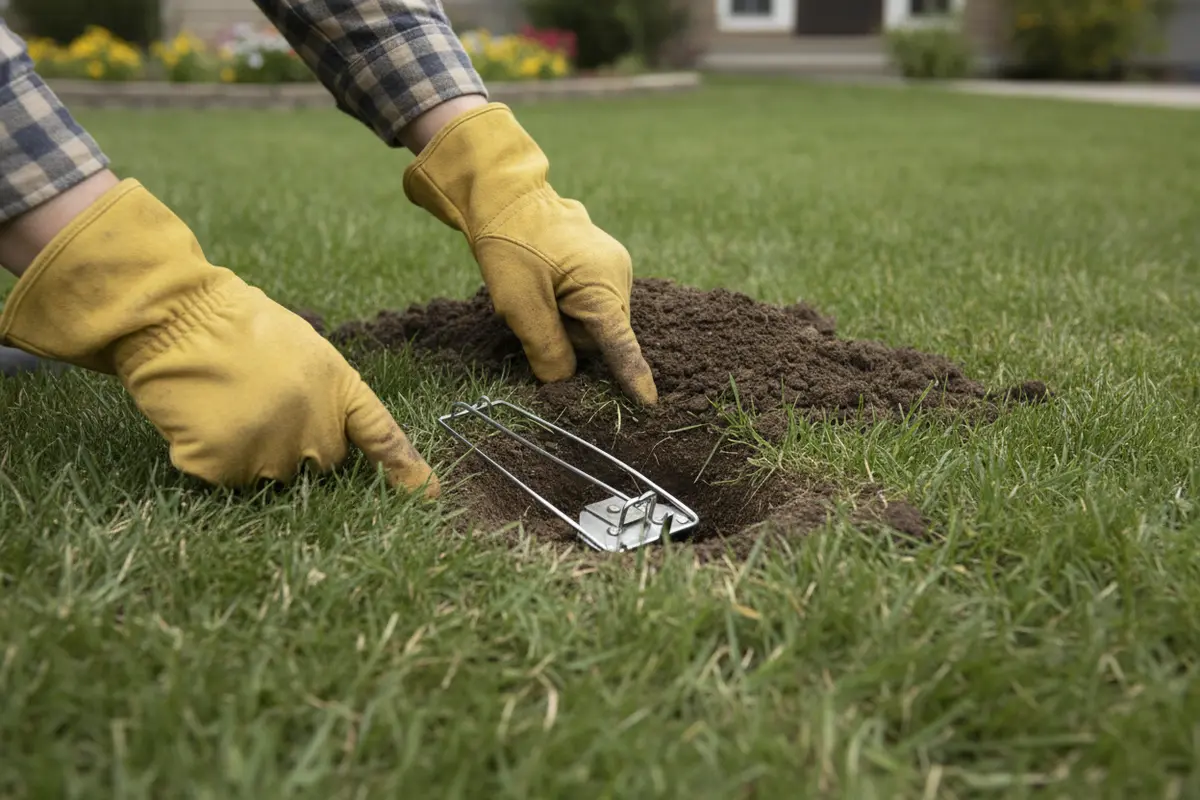
Do not pick a trap solely because it is advertised as “humane,” “safe,” or “legal.” Such labels do not answer whether a particular device is permitted in your jurisdiction or whether it is appropriate for the animal in your yard. Ask for a precise product description and confirm the rule independently.
It also helps to separate identification, efficacy, and legality into three distinct questions. First, what animal is making the damage? Second, will this device work for that animal and the way it uses the tunnel? Third, is this device and method permitted at this site? A “yes” to one does not settle the other two. For example, a trap can be designed for moles but be poorly suited to an inactive runway; a legal device can still be the wrong choice for a gopher problem.
When you inspect damage, look for repeated signs over time rather than relying on one disturbed patch. A ridge that has been flattened and stays flat may not be an active travel route. Fresh soil or renewed surface disturbance can provide a clue, but local soil and weather affect what you see. If the evidence points to pocket gophers, switch to gopher-specific information and ask about a device designed for that species. Nebraska Extension’s mole-control guidance discusses mole trapping approaches and placement; use it for practical context, not as a statement of local law.
Bottom line: correct identification and a device-specific legal check should come before setting any trap.
Related products

How do common options compare before you decide?
Homeowners often compare mechanical traps with baits, repellents, or simply hiring a professional. The legal questions are not identical for each approach. A product that is not a trap may still have label directions or other restrictions, while professional services may be subject to licensing rules. This table is a decision aid, not a statement that any option is permitted everywhere.
| Option | What to verify | Practical consideration |
|---|---|---|
| Mechanical mole trap | Whether the device and its use are allowed locally; any permit, placement, or checking requirements | Requires accurate pest identification, active-run placement, and attention to people and pets |
| Bait or pesticide product | Product label directions, permitted use site, and applicable state or local requirements | Must be used strictly as directed; do not assume rules for traps apply to it |
| Repellent or other non-trap product | Label claims and use directions, plus any local restrictions | Consider whether the product addresses the cause and pattern of the damage |
| Professional wildlife or pest service | Required licenses, qualifications, and the service's proposed methods | Ask what animal they identified, what method they plan to use, and what follow-up involves |
Whatever the method, ask for clarity before acting. If you hire help, request the provider's proposed approach in writing and check any applicable licensing with the relevant state agency. If you choose a mechanical trap, learn where the animal is traveling and follow its directions rather than setting it at random. The aim is a well-informed, lawful response to the damage—not simply purchasing a device.
Compare options by asking what each one requires from you after the first decision. A mechanical trap calls for locating an appropriate runway, following the setup instructions, and checking it according to the directions and local rules. For a pesticide or bait, the exact label matters: confirm that the product is intended for the target animal and permitted use site, then follow every use and storage direction. A service provider should explain the method, any relevant license, access needed, and how the work will be monitored. These practical differences can matter as much as the initial purchase.
Cost alone is not a reliable way to compare methods. Consider whether an approach is reusable, whether it requires repeat applications or service visits, and whether you have the time and confidence to carry it out correctly. Do not infer a cost, success rate, or legal status from a broad product category. Get current product information and local requirements before deciding, especially if children, pets, livestock, or neighboring properties could be affected.
Bottom line: compare methods by their rules and real-world requirements, not by broad marketing labels.
What mistakes can create avoidable problems?
Many problems begin when a homeowner treats an online answer as universal. An article written for another state may not reflect your local code. An old post may describe a rule that has changed. Even an official page can discuss a different species or a different kind of trap. Check the source's location, date, and exact subject before relying on it.
- Assuming all burrowing animals are the same: Identify the animal rather than buying a mole trap for every mound or ridge.
- Assuming all traps have the same legal status: Give the authority the specific product and ask about its mechanism.
- Confusing purchase with use: Being able to order a product does not, by itself, establish that its use is permitted at your address.
- Ignoring local layers: Check city or county rules as well as state guidance.
- Skipping product directions: Follow the manufacturer's instructions and avoid improvising a setup.
- Setting near unintended traffic: Consider children, pets, and non-target wildlife when choosing a location, while meeting any local requirements.
Setup mistakes can also make a trap ineffective, which may tempt a person to leave it in place or move it without a plan. First confirm that the tunnel is active and that the device is positioned as directed. The University of Missouri Extension's guidance on nuisance moles discusses trap placement and runway alignment; its recommendations are practical trapping information, not a statement of the law in your jurisdiction. Read the extension's mole-control guidance and continue to follow local rules.
If you cannot confirm legality, pause. Ask an agency, consult a qualified local professional, or choose another lawful approach after checking its requirements. Uncertainty is a reason to verify—not to assume permission.
One common research mistake is to stop after finding a page that says trapping is allowed or describes a method. Look for qualifications: Does the page address private property? Does it cover the species and device you have? Was it written for your state? Does it link to a rule that has since been amended? A university extension publication can be valuable for animal behavior and practical technique, but it is not a substitute for a current local ordinance or state regulation. Likewise, a government page may be educational rather than the enforcement office’s complete interpretation.
Another mistake is to make a last-minute change after setting a device. If you discover a potential restriction, do not move a trap to a different property or alter its setup as a workaround. Safely follow the manufacturer’s directions and contact the appropriate authority for next steps. Make sure another household member knows where any trap is located and what the instructions require, particularly if the yard is shared with children or pets. Clear communication helps prevent someone from accidentally disturbing a device or assuming it is no longer in use.
Bottom line: avoid relying on generic claims, and stop to verify when the animal, trap, or local rule is uncertain.
What is a responsible pre-setting checklist?
Before setting a trap, make sure you can answer each of these questions:
- Have I identified the animal as a mole rather than a gopher or another species?
- Have I checked the current state rules and the city or county code for this exact location?
- Have I asked the responsible agency whether this trap design is covered by a restriction or permit requirement?
- Am I on property where I have permission to set the device?
- Have I read the manufacturer's instructions and chosen a location that limits access by children, pets, and non-target animals?
- Do I know what local rules require for checking, removing, or handling a captured animal?
If any answer is no, get the missing information before proceeding. Save the agency's written guidance or note whom you spoke with and when. Laws and local codes can change, so recheck when moving to a new address or using a different device. Cinch's company information explains its Oregon-made products and background, while the local authority remains the source for the rules that apply where you live.
Make the checklist specific to the place and method. If you move the trap to another parcel, switch from a mole device to a gopher device, or change from private to shared or public land, revisit the legal check. A rule that applies to one device or address is not automatically transferable. If you are setting more than one trap, ask whether the rules impose requirements based on number or placement, instead of assuming the same answer applies to any quantity.
It is also useful to have a simple record: the animal you believe is present, the device model and instructions, the agency contact, the date you checked, and any permit or code reference. If the answer came with conditions, write those down in plain language and confirm them against the source. That record keeps a practical decision from depending on memory, especially when several people maintain the yard.
Review mole trap and kit options
Bottom line: identify, verify, get permission, and understand the instructions before setting a trap.
Frequently asked questions
Are mole traps legal in every state?
There is no one answer that safely covers every state, local rule, trap design, and use. Check the current rules for your address with the state agency responsible for wildlife or trapping and the relevant local government.
Can I use a mole trap in my own yard?
Private ownership does not automatically answer every regulatory question. Confirm state and local rules, any property restrictions, and whether the specific device is allowed for the animal and location.
Does a store selling a trap mean it is legal to use?
No. Availability for sale does not establish that a particular use is permitted at your location. Verify use requirements with the agency that enforces them.
Are rules for mole traps the same as rules for gopher traps?
Not necessarily. The animal, device, and applicable law may differ. Identify the pest and ask the responsible authority about the specific trap you plan to use.
Who should I contact if the rules are unclear?
Start with your state wildlife or fish and game agency and your city or county government. Ask them to identify the correct office and provide the current regulation or written guidance.
Bottom line: when in doubt, get a current, location-specific answer from the government office responsible for enforcement.
Choose your next step with confidence
For most homeowners, the safest next step is straightforward: identify the animal, confirm the trap's classification, and check the rules where the trap will actually be used. Once those questions are answered, follow the product instructions and set it only where you have permission and can manage it responsibly.
Explore Cinch mole traps and kits
Taking time to verify the details helps you protect your yard without guessing about the rules.
Bottom line: do the local legal check first, then choose a method that fits both the animal and your property.