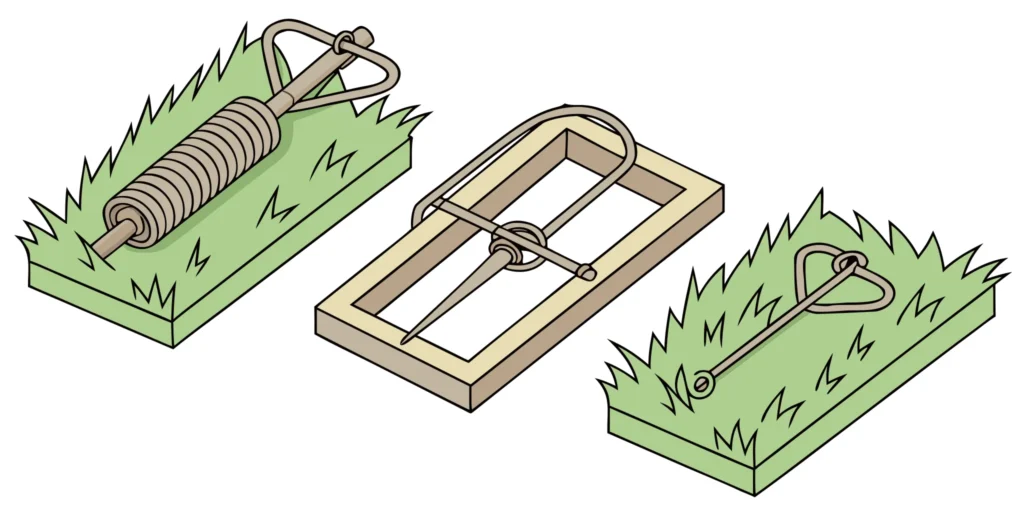
Mole traps can look similar on the shelf, but their mechanisms place different demands on setup, tunnel placement, and handling. The right choice depends on whether you value beginner-friendly setting, deep-run performance, or a reusable design that simplifies the process.
A useful mole trap comparison starts with the three main styles: scissor-jaw traps clamp across the tunnel. Harpoon or spear traps drive prongs down through the run, and Cinch-style traps use a distinct mechanism designed for straightforward setting and removal. All three can work when placed in an active tunnel, but ease of use, safety considerations, and consistency vary by design.
Kansas State University identifies harpoon, choker, and scissor-jawed traps as the primary types, and notes that each may require practice to master. Placement matters as much as the trap itself, so the practical differences begin with how each style interacts with the tunnel. Start with the scissor-jaw design and its setting requirements.
How Scissor-Jaw Mole Traps Work
Scissor-jaw traps use two metal jaws that straddle the mole’s tunnel. When the mole pushes through an obstruction at the trigger, the jaws snap shut around the run. The mechanism is straightforward, but placement determines whether the trap meets a mole or sits untouched in an empty branch.
Scissor-jawed traps are one of the three primary mole-trap designs, alongside harpoon and choker-style traps. Kansas State University notes that each type can work, although all require some practice to master. Its guidance also identifies trapping as the most effective control method, while poison baits, chewing gum, and noise devices often fail because moles feed on earthworms and grubs rather than vegetable matter. Kansas State’s mole-control guidance provides the research-based explanation.
Why tunnel placement matters
Start with an active tunnel, not the most noticeable mound. A visible mound may connect to a side branch that the mole no longer uses. Place a test hole in several runs with a broomstick or similar tool, then check the holes the next day. A repaired hole indicates activity. Once you identify a working run, position the scissor trap at least 18 inches from any mound. This distance helps keep the trap in a main tunnel rather than a short dead-end branch.
Set the jaws so they straddle the tunnel, with the trigger positioned where it creates a small obstruction. The obstruction gives the mole a reason to push against the trigger as it travels through the run. A trap that is centered beside the tunnel, rather than over it, can have a sound mechanism and still miss the animal.
Deep and shallow runs
Deep runs require opening enough of the tunnel to seat the trap securely and preserve the mole’s path through the jaws. In Western Washington, deep runs commonly sit 6 to 20 inches below the surface, according to field guidance from Got Moles. The exact depth varies with soil and local conditions, so avoid choosing a trap location by surface appearance alone.
Shallow runs are simpler to access. When less than one inch of soil separates the top of the run from the surface, scissor traps can often be set from above without excavating the tunnel. Work carefully so loose soil does not collapse the passage or bury the trigger before the trap is ready.
Victor is the most familiar scissor-trap brand, with typical prices around $15 to $30 per trap. A field comparison from Got Moles makes the larger point about equipment: a $30 Victor placed in a high-traffic deep run can outperform a $200 collection of gadgets scattered over surface tunnels. The value comes from finding the mole’s route, not from accumulating devices.
Scissor-jaw traps are the workhorse option when their jaws straddle a confirmed active tunnel, the trigger creates a clear obstruction, and the trap is placed correctly.
How Harpoon Mole Traps Work
A harpoon, or spear, trap uses a set of pointed prongs that drop into the tunnel when the trigger is disturbed. To set one, locate a confirmed active run and center the trap directly over it. The prongs must line up with the tunnel rather than sit to one side, because the mole has to encounter the mechanism as it moves through the passage.
The trigger works by creating an obstruction in the mole’s path. Depress a small area of loose soil in the top of the run where the trigger will sit. As the mole pushes dirt forward and meets that obstruction, the movement releases the spring-loaded prongs. The trap then drives downward into the tunnel. This approach uses the mole’s normal tunneling behavior instead of bait.
Harpoon traps are often considered the easiest option for beginners. They generally require less soil manipulation than scissor-jawed traps, and a shallow run can make setup especially straightforward. When there is less than one inch of soil between the top of the tunnel and the surface, a harpoon trap can often be placed from above without excavating the run. That convenience makes it a useful starting point for someone learning the basics of a mole trap comparison.
Where harpoon traps perform well
- Shallow, clearly defined runs that are easy to locate from the surface.
- Situations where a simple above-ground setup is preferable to opening the tunnel.
- New trappers who want to learn alignment and trigger placement with a relatively direct mechanism.
Limits to consider
Ease of setup does not guarantee the best result. The prongs can miss if the trap is not centered precisely over the run. A mechanism may also jam if soil, roots, or other debris interferes with its movement. Those problems can leave the tunnel undisturbed while making the trap appear ready. Scissor traps can demand more care during setup, but their jaws may offer more consistent contact when positioned correctly in a suitable run.
Harpoon traps are simpler, not effortless. Kansas State University Extension identifies harpoon, scissor-jawed, and choker traps as the three primary types, and notes that each can take time to master. Whichever design you choose, confirm the tunnel is active and pay close attention to alignment.
Harpoon traps are a beginner-friendly choice for shallow runs, but accurate centering and a clean, working mechanism still determine whether the trap succeeds.
What Makes Cinch-Style Traps Different
Scissor-jaw and harpoon traps work from the surface of a mole runway. A scissor trap straddles the tunnel with jaws that close across it, while a harpoon trap centers its prongs over the run and drives them downward. Those designs can be effective, but success depends on precise alignment and enough soil access to position the trap correctly.
A Cinch-style trap approaches the runway differently. Its tunnel-style mechanism sits inside the mole’s active passage rather than straddling the tunnel or spearing into it from above. The mole encounters the mechanism while moving through its established route. That design gives homeowners, landscapers, and professional trappers a more contained setup with less surface hardware around the runway.
A setup built around the mole’s runway
With a Cinch trap, placement starts by finding an active tunnel, not by guessing from the nearest mound. Once the runway is identified, the setup follows four straightforward steps. The process does not require handling a dead animal after the trap works, which makes cleanup less unpleasant and keeps the procedure focused on restoring the damaged area.
- Locate a regularly used runway.
- Prepare the tunnel for the trap.
- Set the mechanism in the mole’s path.
- Check the trap and reset or remove it as needed.
Like any mechanical trap, a Cinch-style model still depends on choosing an active tunnel. The mechanism cannot work in an abandoned branch. The difference is that its tunnel-level design is intended to meet the mole where it is traveling, rather than requiring the animal to trigger jaws or prongs positioned above the runway.
Built for repeated use
Cinch Traps has handcrafted mechanical pest-control products in the United States since 1909. The company backs its traps with a lifetime guarantee, reflecting a focus on durable construction rather than disposable equipment. Cinch-style traps are also identified in the supplied brand materials as ranked number one by five major universities and the USDA. That claim is part of the company’s positioning. While independent trapping guidance still emphasizes the fundamentals that apply to every design: use an active run and place the trap carefully.
For readers making a mole trap comparison, the key distinction is the interaction point. Scissor and harpoon traps act across or down into the runway from above. A Cinch-style trap works within the tunnel itself, with a four-step setup and no need to handle dead animals.
Cinch-style traps stand apart by placing a simple, reusable mechanism inside the mole’s runway, combining tunnel-level operation with a four-step setup, American craftsmanship, and a lifetime guarantee.
How a Side-by-Side Mole Trap Comparison Helps You Choose
These three trap styles solve the same problem with different trigger designs and setup demands. The right choice depends on the tunnel you can access, your comfort with setting the mechanism, and how consistently you can place the trap in an active run. Kansas State University Extension identifies harpoon, scissor-jawed, and choker-style traps as the three primary types, noting that each can work but may take practice to master. Read the university’s trapping guidance for placement fundamentals.
| Factor | Scissor-jaw | Harpoon or spear | Cinch-style |
|---|---|---|---|
| Mechanism | Jaws straddle the tunnel and close when the mole contacts the trigger. | Prongs are centered over the tunnel and drive downward through the run. | A compact trigger-and-clamp design built to engage the mole in the tunnel. |
| Ease of setting | Moderate. Accurate jaw alignment and tunnel preparation matter. | Often the easiest style for beginners, with less soil manipulation than a scissor-jaw. | Designed for straightforward setting, though correct placement still determines results. |
| Safety considerations | Keep hands clear of the closing jaws and secure the set trap from children and pets. | Keep hands and people clear of the raised spring and descending prongs. | Handle the tensioned mechanism carefully and restrict access around the set. |
| Escape risk | Higher when the jaws do not straddle the active run or the trigger is poorly positioned. | Higher when the prongs are off-center or the mole can pass around the trigger. | Lower when the trap is correctly fitted to the active tunnel, but no style compensates for a dead run. |
| Effectiveness evidence | A $30 Victor scissor trap in a deep, high-traffic run was reported to outperform a $200 collection of gadgets. | Can be effective when centered over the run; university guidance lists the style among the primary workable options. | Molecatching.com lists Cinch among its three best mole traps. |
| Best use case | Experienced users targeting a confirmed deep or high-traffic runway. | First-time trappers who want a simpler setup and have a suitable shallow or exposed run. | Users who want a repeatable, purpose-built trap and can identify an active runway. |
| Price range | Varies by brand and model; the documented Victor example costs about $30. | Varies by brand, construction, and retailer. | Varies by model and retailer; check current product pricing before purchase. |
Price alone does not predict performance. Placement is the shared deciding factor: a trap must interact with a mole in an active tunnel. For a closer look at scissor-jaw and Cinch designs, read our mole trap comparison.
For a mole trap comparison, choose the style that matches your setting experience and tunnel access, then prioritize precise placement over price or gadget count.
What University Research Says About Mole Trap Effectiveness
University extension guidance points to trapping as the most dependable way to control moles. Kansas State horticulture expert Drew Ricketts identifies traps as the best control method and explains why poison baits are a poor fit: moles feed on earthworms and grubs, not vegetable matter. That distinction matters when choosing between products marketed for rodents or other yard pests. Read the Kansas State Extension guidance on mole control.
Why mole behavior makes trapping practical
Moles are active hunters, not root-eating herbivores. Iowa State University Extension reports that a mole may need to consume nearly 100% of its body weight in food each day, mostly from the invertebrates found in its tunnel system. A Townsend mole can dig up to 18 feet of new tunnel in an hour, according to field guidance compiled by Got Moles. Those demands keep the animal moving through active runs, creating opportunities for a correctly placed trap.
It is also important to identify the damage accurately. Moles do not eat plant roots, although their tunneling can disturb roots and uproot small plants. The problem is the tunnel network and the soil disruption, not feeding on the roots themselves. That is why a trap placed in an active runway addresses the cause of the visible damage more directly than a root-protection product or an undirected bait.
Testing supports the value of comparing trap designs
Extension research recognizes three primary trap types: harpoon, choker, and scissor-jawed. Each can work, but each requires the user to learn its setting and placement requirements. Independent testing adds useful context without replacing proper field technique. Bob Vila tested six popular mole traps over four weeks and reported the Polaflex galvanized steel scissor trap as the highest-performing option in that test.
That result does not mean every yard will produce the same outcome. Soil, tunnel depth, species, and placement all affect performance. A useful Victor vs Cinch comparison should therefore consider mechanism and setup, not just a single test ranking. The strongest evidence consistently favors a properly matched trap in a confirmed active tunnel.
Research-backed mole trap effectiveness comes down to using a trap in an active runway, where the mole’s constant search for food brings it into contact with the mechanism; university guidance favors trapping over ineffective poison baits.
How to Choose the Right Mole Trap for Your Property
The most expensive trap will not work if it is set in an inactive branch. Before comparing mechanisms, spend a few minutes confirming where the mole is actually traveling. Placement, tunnel depth, and soil conditions should guide the choice.
- Find an active run. Use a broomstick or similar tool to make small test holes in several suspected runs. Check them the next day. A repaired hole shows that the tunnel is being used, while an untouched hole is a poor location for a trap. This approach follows guidance from K-State Extension, which notes that moles use some tunnels more often than others.
- Stay away from visible mounds. Do not set directly beside a mound. Place the trap at least 18 inches away, in a confirmed active tunnel. Mounds often mark a branch or endpoint rather than the main travel route. A main run gives the trap more opportunity to intercept the mole as it moves through the property.
- Create an obstruction at the trigger point. Once you have selected the run, depress a small amount of loose soil in the tunnel where the trigger will sit. The obstruction encourages the mole to interact with the mechanism instead of simply passing beneath it. Follow the detailed instructions in this guide to proper trap placement, including how to position the trap over the tunnel.
- Match the trap to the tunnel. Deep runs in sandy or loamy soil may sit 6 to 20 inches below the surface. Those conditions are well suited to a scissor trap designed for a deeper tunnel. Sandy and loamy soils are also favorable burrowing ground, according to Iowa State University Extension. Shallow runs are a different job: when less than an inch of soil covers the tunnel. A harpoon or Cinch-style trap may be set from above without extensive excavation.
- Choose the mechanism you can set accurately. Scissor jaws straddle the run, while harpoon prongs are centered over it. If you are new to trapping, a simpler mechanism may be easier to position consistently. For regional soil and placement considerations, review these regional mole control guides before setting traps.
The best trap for your property is the one matched to the tunnel and placed in a confirmed active run. At the correct depth and distance from the mound.
Frequently Asked Questions
Which type of mole trap is most effective?
Scissor-jaw, harpoon, and Cinch-style traps can all work when matched to an active tunnel and set correctly. The trap mechanism matters, but placement matters more. Confirm activity first, then create an obstruction at the trigger so the mole interacts with the trap. K-State Extension identifies trapping as the most effective mole-control method compared with remedies such as poison baits and noisemakers: K-State guidance on mole control.
Are harpoon traps easier to set than scissor-jaw traps?
Generally, yes. Harpoon traps are often considered the easiest option for beginners because the prongs are centered over the tunnel and require less soil manipulation. Scissor-jaw traps need their jaws to straddle the run, so accurate alignment is essential. Both styles may be set from above when the tunnel is less than one inch below the surface.
How do I choose the right trap for my yard?
Start with the tunnel, not the brand. Test several runs by making small holes and checking which ones the mole repairs within a day. Set the selected trap in that active passage, ideally away from a visible mound rather than in a dead-end branch. Soil depth, tunnel shape, and your comfort with the setting process should then guide the choice between scissor-jaw, harpoon, and Cinch-style designs.
Are mole traps safe to use around pets and children?
Any spring-loaded or penetrating trap can injure a curious person or animal. Read the manufacturer instructions, keep hands clear while setting, and place the trap only where children and pets cannot reach it. Mark or monitor the location, and remove the trap promptly after it has fired. Never leave a set trap exposed in a play area, walkway, or other high-traffic location.
Ready to choose a mole trap that fits your yard and trapping goals? Cinch Traps offers durable, professional-grade options designed for practical use, whether you are protecting a garden, lawn, or larger property. Review the available models, compare the features, and order directly from the store with flat rate shipping.
Shop professional-grade mole traps at Cinch Traps and find the right option for your property.