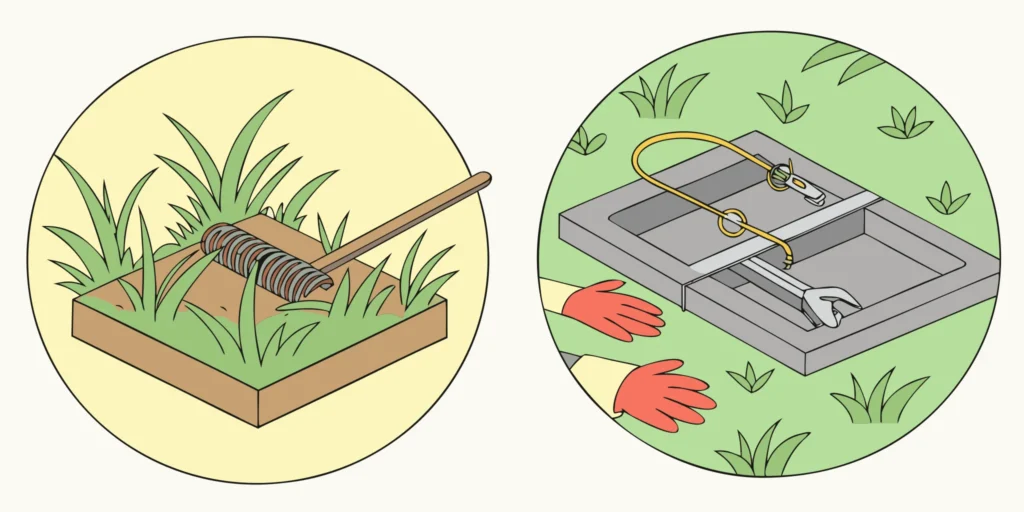
Choosing a gopher trap is not only an upfront price decision. A trap that lasts through repeated seasons can cost less than a lower-maintenance-looking option that needs replacement parts. While a surface-set design may save time when digging is difficult.
The best gopher hawk vs cinch choice depends on what you value over time: GopherHawk offers surface-set convenience, while Cinch emphasizes durable galvanized-steel construction, a lifetime guarantee, and a tunnel-based scissor-action design. Comparing purchase price, setup requirements, durability, and likely replacement costs gives you a clearer measure of value than the shelf price alone.
That longer view starts with the numbers. We will compare what each option delivers for the initial investment, then examine how materials, mechanisms, and maintenance affect the cost of controlling gophers season after season.
Gopher Hawk vs Cinch Trap Price Comparison and Value Engineering
Upfront price matters, especially when you are deciding how many traps a yard or garden needs. A single Cinch gopher trap is listed at $24.99, while a single GopherHawk trap is $32.95. That makes the GopherHawk about 32% more expensive than the Cinch at the single-trap price point, or puts nearly $8 back in the buyer’s budget for each trap.
The package options change the calculation. Cinch’s Deluxe Gopher Kit costs $64.99 and includes three traps, gloves, flags, a tunnel clear tool, and maintenance spray. That works out to about $21.66 per trap before assigning any value to the included tools and supplies. GopherHawk’s $42.95 trapping set includes one trap and a wedge/probe tool, which works out to $42.95 per trap. The simple comparison looks like this:
- Cinch single trap: $24.99, or about 0.040 traps per dollar.
- GopherHawk single trap: $32.95, or about 0.030 traps per dollar.
- Cinch Deluxe Gopher Kit: $64.99 for three traps, or about 0.046 traps per dollar.
- GopherHawk trapping set: $42.95 for one trap plus a wedge/probe tool.
Those ratios do not determine which design fits every property. GopherHawk’s tool-assisted approach may appeal to someone who wants to work from the surface. Cinch is built for placement in an active tunnel, so the labor and soil conditions involved in setting it deserve consideration alongside the purchase price. If you are comparing options for a garden, review the guidance on choosing the best gopher trap for gardens before deciding how many units you need.
Where materials affect the value calculation
The longer-term value question comes down to what is being purchased for that initial price. Cinch traps are handmade in America from galvanized steel and backed by a lifetime guarantee. That construction is intended for repeated use across seasons, with the guarantee providing a clear durability promise.
GopherHawk uses a different mechanism, typically a snare or coil-style design, while Cinch uses a scissor-action design for tunnel placement. The mechanisms serve different setup preferences, but they also represent different material and maintenance choices. A lower per-trap price is most useful when the trap remains serviceable for the work ahead. A convenient setup is most useful when it matches the property’s soil, tunnel layout, and the user’s comfort level.
For buyers comparing price and materials, a Cinch single trap costs less than a GopherHawk single trap. While the Deluxe Gopher Kit offers the lowest listed cost per trap and adds setup supplies. Its galvanized-steel construction and lifetime guarantee also make durability part of the value equation.
How Each Trap Design Affects Setup and Placement
The biggest practical difference between these traps is where the mechanism works. GopherHawk is designed for a surface-set approach. You locate an active tunnel, make a vertical opening, and insert the trap from above. Its snare or coil-style mechanism can reduce the amount of tunnel excavation, which is useful when you want to make a quick set with limited soil disturbance. The wedge and probe tool helps locate and prepare the tunnel, but it is an additional purchase.
Cinch uses a scissor-action mechanism that sits directly in the gopher’s tunnel. That placement requires opening the tunnel enough to position the trap across the animal’s travel path. It is a more hands-on setup, but the trap is working inside the existing tunnel rather than trying to intercept the gopher from the surface.
| Factor | GopherHawk | Cinch |
|---|---|---|
| Design type | Snare or coil-style mechanism | Scissor-action mechanism |
| Placement method | Surface-set with vertical insertion into the tunnel | Placed directly across an opened gopher tunnel |
| Digging required | Usually less digging and tunnel exposure | Requires opening the tunnel to position the trap |
| Extra tools needed | Wedge and probe tool, typically sold separately | Setup tools are included with the trap kit |
| Operation mechanism | Snare or coil captures the gopher from the surface-set position | Scissor jaws close within the tunnel |
Why soil conditions can change the experience
Soil matters as much as the mechanism. In its comparison of traps used for pocket gopher management in alfalfa fields. Utah State University reported that Cinch traps were effective, while setting them could be more difficult in certain field-soil conditions. Firm, compacted, rocky, or root-filled ground can make tunnel access slower. Loose soil may make opening and closing the tunnel easier, but it can also collapse during setup.
That does not make one design universally better. GopherHawk favors speed and less digging at the surface. Cinch favors direct tunnel placement and a straightforward scissor action once the tunnel is exposed. The right choice depends on whether your priority is minimizing excavation or placing the trap directly in the gopher’s established route.
GopherHawk is generally the more convenient surface-set option with less digging. While Cinch requires tunnel access but provides direct scissor-action placement; soil conditions should be part of the decision.
Setup Process, Durability, and Warranty Compared
The biggest setup difference is where each trap works. Cinch is placed inside an active tunnel, while GopherHawk uses its wedge and probe tool to create an artificial tunnel from the surface. The right choice depends on whether you prefer working with the gopher’s existing runway or making a new access point.
How the Cinch setup works
Cinch uses a straightforward four-step process:
- Find an active gopher tunnel.
- Open the tunnel carefully.
- Set the trap in the runway.
- Cover the opening so light does not enter.
That tunnel placement puts the scissor-action trap where the gopher already travels. It also avoids the unpleasant step of handling a dead animal. After checking the trap, you can remove the catch and reset the unit as needed. For placement and lure questions, this guide to gopher trap baiting covers the practical details.
How GopherHawk approaches setup
GopherHawk takes a different route. Its wedge and probe tool helps create an artificial tunnel, allowing the trap to be set from above without opening the gopher’s original runway in the same way. That can be convenient when surface access is easier than locating and exposing a natural tunnel. The tradeoff is that the tool and placement method become part of the setup process, and the artificial tunnel must intersect the gopher’s travel path to work.
What happens after repeated use?
Durability becomes more important when a property needs multiple trapping cycles. Cinch traps are handmade in America from galvanized steel and backed by a lifetime guarantee. The metal construction is intended for repeated seasonal use, rather than replacement after a limited number of catches.
GopherHawk uses a strap-based mechanism with replacement strap cartridges priced at $8.95 each. The replaceable design gives owners a way to renew the working part, but it also creates a recurring consumable cost over time. A Home Depot customer review comparing the two products described Cinch as “more effective and durable in the long run,” an opinion that aligns with the difference between a lifetime-guaranteed steel trap and a system that may require replacement cartridges. See the Home Depot Cinch product listing for the customer review context.
Cinch is the simpler tunnel-set option, with galvanized-steel construction and a lifetime guarantee; GopherHawk offers surface-created tunnel access but relies on replacement straps as its working component.
Trapping Effectiveness: University Studies and Real-World Results
When comparing gopher traps, setup speed is only one part of the question. The more important measure is whether the trap consistently reaches the gopher’s active tunnel and performs in the conditions found beneath a lawn, garden, or field.
Cinch traps have ranked number one in studies conducted by Oregon State University. UC Santa Cruz, the University of Michigan, the University of California, and the University of Nevada. The USDA National Wildlife Research Center also described the Cinch Trap as “the all-around best performer.” Together. Those results provide stronger evidence than a single customer review or a quick comparison in ideal soil.
Why tunnel placement matters
GopherHawk’s surface-set approach can be convenient because it may require less digging and can be faster to place per trap. That advantage is useful when a homeowner needs to cover several visible mounds quickly. It does not necessarily make the trap the better choice for every tunnel system, however. Deep, established, or irregular burrows can be easier to address by opening the tunnel and setting a trap directly in the gopher’s travel path.
Cinch uses a scissor-action design intended for tunnel placement. That process can take more effort in hard or compacted soil. A Utah State University study found Cinch traps more effective overall, while also noting that they were harder to set in some conditions. The tradeoff is practical: GopherHawk may be quicker at the surface, while Cinch can offer a stronger fit when accurate tunnel placement is the priority.
Results beyond controlled studies
Field experience points in the same direction. Customer Perry Smith reported catching 501 gophers in three months with 21 Cinch traps. That result does not guarantee the same count in every property, since soil, tunnel activity, and infestation size vary. It does show what a coordinated trapping program can accomplish when traps are placed across active tunnel systems and checked consistently.
For regional tactics, the California gopher control guide offers additional guidance on identifying activity and planning control work. In any location, success depends on finding active tunnels, setting the trap correctly, and revisiting the area when new mounds appear.
University studies and field results favor Cinch for overall trapping effectiveness, especially in established tunnel systems, while GopherHawk retains a practical speed advantage for surface setting.
Long-Term Value: Which Trap Costs Less Over Three Years?
Upfront price only tells part of the story. A trap that needs replacement parts can cost more each season, while a durable trap may continue working without another purchase. The projections below use the listed product prices and assume one GopherHawk strap replacement after two seasons, then another after four seasons. Actual replacement timing depends on use, soil, and wear.
Single-trap cost projection
| Option | 1 year | 3 years | 5 years |
|---|---|---|---|
| Cinch single trap | $24.99 | $24.99 | $24.99 |
| GopherHawk single trap | $32.95 | $41.90 | $50.85 |
The Cinch single trap is made from galvanized steel and backed by a lifetime warranty, so the projection has no recurring replacement cost. GopherHawk lists the single trap at $32.95, with replacement strap cartridges priced at $8.95 each. Under the two-season replacement assumption, the GopherHawk option costs $8.95 more after three years and $25.86 more after five years.
Six-trap coverage for a typical yard
| Coverage option | 1 year | 3 years | 5 years |
|---|---|---|---|
| Cinch Deluxe Gopher Kits, 2 kits (6 traps) | $129.98 | $129.98 | $129.98 |
| GopherHawk 7 Trapping Sets bundle | $300.65 | $363.30 | $425.95 |
Two Cinch Deluxe Gopher Kits provide six traps for $129.98, and the lifetime warranty keeps that purchase stable across the projection. The GopherHawk seven-set bundle costs $300.65 before replacement straps. If all seven sets receive one replacement cartridge after two seasons and another after four, those parts add $62.65 per cycle, bringing the estimated five-year total to $425.95.
For buyers comparing gopher hawk vs cinch over multiple seasons. Cinch costs less over time because its galvanized-steel traps are lifetime warrantied and do not require recurring strap purchases.
Which Gopher Trap Should a Homeowner Choose?
The right choice depends on where you are willing to work and how often you expect to trap. GopherHawk is designed for a surface-set approach, which can reduce digging and make quick placement attractive for homeowners who want a simpler setup. Cinch uses a scissor-action trap placed inside an active tunnel, requiring more attention to locating and opening the tunnel but putting the trap where the gopher travels.
Choose surface-set convenience for quick spot treatment
GopherHawk can make sense when convenience is the main priority. A homeowner treating one visible mound, managing a small problem. Or working in soil where opening a tunnel is difficult may prefer a trap that can be set from the surface. It is also a practical option when speed matters more than building a reusable trapping system for repeated control.
That convenience comes with a different long-term consideration. GopherHawk relies on a snare or coil-style mechanism, and its strap components may need replacement as they wear. For someone who expects to trap only once, that may not matter. For recurring activity, replacement parts and repeated purchases belong in the comparison.
Choose tunnel-set control for established activity
Cinch is a stronger fit when gophers are repeatedly damaging a garden, lawn, orchard, or larger property. Pocket gophers spend almost all of their time in underground tunnels, typically 4 to 18 inches below the surface. So placing a scissor-action trap in an active tunnel targets the animal’s normal route. Their territorial behavior also means that one active burrow can represent one gopher, making accurate placement important. Read our guide to the best gopher trap for gardens for more placement guidance.
Cinch traps are handmade in America from galvanized steel and backed by a lifetime guarantee. The four-step setup is designed to avoid handling a dead animal, which can matter when a homeowner expects to reset traps over several seasons. Professionals and owners of larger properties may also value a durable trap that can be moved from one active tunnel to the next instead of treated as a disposable purchase.
Match the purchase to the property
- Small garden: Choose GopherHawk for fast surface placement, or Cinch when recurring damage justifies a reusable tunnel trap.
- Large property: Favor Cinch when multiple traps and repeated resets make durability and long-term value more important.
- Professional use: Cinch is the better fit for a repeatable tunnel-based process across multiple properties.
For a one-time problem, GopherHawk’s surface-set convenience may be worthwhile. For recurring damage, larger properties, or buyers focused on durability and long-term value, choose Cinch and place it in the active tunnel.
Frequently Asked Questions
Which is better, a GopherHawk or Cinch trap?
The better choice depends on the job. GopherHawk offers a surface-set approach that can reduce digging, while Cinch uses a scissor-action design placed in an active tunnel. For buyers weighing long-term value, Cinch combines a lower upfront price with galvanized steel construction and a lifetime guarantee. Soil conditions, access to the tunnel, and how often you plan to reuse the trap should guide the decision.
How do Cinch traps work?
A Cinch trap is placed inside an active gopher tunnel, where its scissor-action jaws are positioned to intercept the animal’s movement. The setup follows four steps and is designed so the user does not need to handle the captured animal. Correct tunnel placement matters more than simply setting a trap near a visible mound.
Are Cinch traps effective for gopher control?
Yes. Trapping is recognized as a highly effective, non-chemical method for controlling pocket gophers by Oklahoma State University Extension: OSU Extension guidance on pocket gopher control. Cinch’s tunnel placement targets the underground system where gophers spend most of their time. And the brand reports that its design has been refined for more than 116 years.
Will a Cinch trap cost less over several seasons?
It can, especially when the same trap is reused. Cinch traps are made from galvanized steel and backed by a lifetime guarantee, so the initial purchase is not automatically followed by a recurring trap or strap cost. Actual savings depend on how many traps you need, how carefully they are stored, and the conditions in which they are used.
Which trap is easier for a first-time homeowner to use?
GopherHawk may appeal to homeowners who prefer a surface-set method with less tunnel excavation. Cinch requires locating an active tunnel, but its four-step process keeps the setup straightforward once the tunnel is exposed. If durability and repeat use matter as much as initial convenience, learning the tunnel placement method may provide better value over time.
Ready to Choose a Durable Gopher Trap?
When long-term value matters, a trap backed by durable construction and a lifetime warranty can make repeated seasons of control easier to manage.
Shop Cinch Gopher Traps online with flat rate shipping and a lifetime warranty.
Cinch gives you a practical next step for protecting your property with a trap built for continued use.