

Do mole traps work? Yes, they can work very well when they are placed in an active runway and set to match the tunnel. University extension guidance consistently points to trapping as the most effective practical control method for problem moles. The important detail is not simply owning a trap. It is putting the trap where a mole is actually traveling.
Shop Cinch mole traps and kits for a durable mechanical control option.
Why Do Homeowners Ask, "Do Mole Traps Work?"
People usually ask this question after trying a string of popular mole remedies. Raised ridges reappear, fresh soil shows up overnight, and a trap may sit untouched while the lawn continues to change. That experience can make a homeowner wonder whether trapping itself is unreliable, when the real problem is often a mismatch between the trap location and the mole's travel pattern.
Moles spend most of their time below ground, where they follow feeding and travel tunnels. A mound is visible, but it is not necessarily the place where the animal spends the most time. A shallow runway that connects feeding areas, follows a straight edge, or shows recent repair is usually a more useful trapping target.
University guidance helps separate those questions from marketing claims. It does not promise that every trap will fire on the first day or that every yard has the same conditions. Instead, the research-based advice is practical: identify active tunnels, use a suitable trap, set it so the mole encounters the trigger, and move it when the evidence says the location is inactive.
- Fresh molehills show activity in the area, but they are not automatically the best trap locations.
- Raised surface runways are more useful when they are straight, recently repaired, or connected to other active signs.
- A trap that remains untouched may be in an abandoned tunnel, poorly aligned, or blocked by soil, roots, or stones.
- Several days without a catch is a reason to assess the setup, not proof that trapping cannot work.
Mechanical mole traps work because they intercept an animal in a confined travel tunnel, but success depends on evidence of current activity and accurate placement. A missed catch usually tells you to reassess the runway, trigger path, or trap position before you dismiss trapping as a method.
What Does University Research Say About Mole Traps?
Recent university extension guidance is unusually direct. In a 2025 article, Kansas State University horticulture expert Drew Ricketts described traps as the best control method for moles. The article also explains why many household remedies do not provide consistent control and notes that poison baits are a poor fit for an animal that feeds on earthworms and grubs. Read the full Kansas State University guidance on mole control for the source advice.
Nebraska Extension uses similarly clear language in its guide Moles and Their Control. It calls trapping the most effective and practical way to control problem moles, while adding that results are highest in frequently used travel burrows. That recommendation matters because it ties the method to a condition that the homeowner can test rather than presenting the trap as a magic object.
| Research-based point | What it means in a yard | What it does not prove |
|---|---|---|
| Trapping is a leading practical control method | A correctly placed mechanical trap is a reasonable first-line option for a problem mole. | Every trap will work in every tunnel or on the first attempt. |
| Active travel burrows matter | Test the runway before setting the trap and focus on a repaired or recently used section. | A fresh mound alone identifies the best placement point. |
| Trap styles differ | Choose a style that fits the tunnel and follow its placement instructions. | One trap design is universally superior in every soil and tunnel. |
| Relocation is part of the process | Move the trap when the location shows no response after a reasonable check period. | A quiet trap automatically means the product is defective. |
The public sources above are extension recommendations, not a claim that every brand has been tested in the same study. Cinch Traps separately identifies university rankings and research support on its About Cinch Traps page. That public brand page does not provide complete study methods and dates in the material reviewed for this article. The more accurate conclusion is that research supports mechanical trapping as a method. Product-specific performance should be judged by correct use and documented evidence.
University research supports trapping as an effective, practical response to problem moles, especially in active travel burrows. The evidence supports the method and the placement principles, not an unconditional promise that any trap will catch a mole regardless of tunnel activity or setup.
Why Does Trap Placement Matter More Than the Trap's Appearance?
A mole trap only works when the mole reaches its trigger or loop. That sounds obvious, but it explains many disappointing results. A polished trap placed over an abandoned ridge is still in the wrong place. A less complicated trap placed squarely in a busy runway has a better opportunity to work. The animal's route comes first, and the hardware comes second.
University of Nebraska guidance recommends looking for frequently used burrows and describes practical ways to set common trap styles in those runs. Kansas State also recommends testing several runs and checking whether a mole repairs the test opening. These recommendations point to a repeatable field habit: disturb a small section, mark it, and return after roughly a day. A repaired opening is useful evidence that the runway is active.
Before setting a trap, look for a combination of signals rather than relying on one clue:
- A long or relatively straight raised ridge instead of only a large mound.
- Soil that looks fresh, loose, or recently pushed up.
- A test opening that is repaired or plugged within 12 to 24 hours.
- A runway that connects several signs of movement or follows a consistent edge.
- A firm, unobstructed place where the trap can sit across or inside the tunnel as designed.
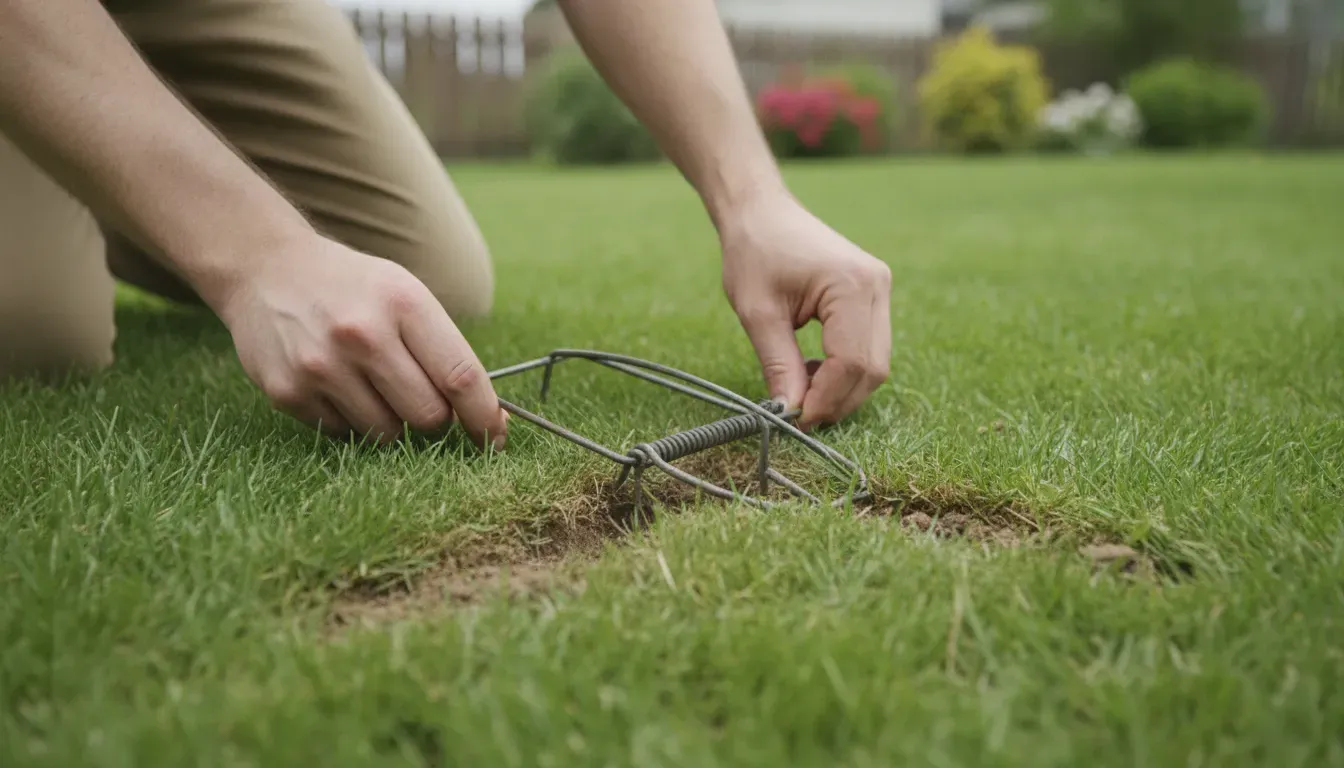
Placement also affects what happens after the trap is set. If light, air, loose soil, roots, or a poorly aligned trigger changes the tunnel, the mole may dig around the disturbance. Follow the instructions for the specific trap, keep the path clear, and cover the setup when the design calls for a dark, closed tunnel. The goal is to let the animal encounter the mechanism during normal travel.
The most important part of making a mole trap work is choosing an active runway and keeping the trap's trigger path clear. Trap appearance matters less than fit, stability, and placement where the mole is already traveling.
See the Cinch setup guidance for practical instructions before placing a trap.
Can a Mole Trap Work If It Does Not Catch a Mole Quickly?
Yes, a quiet trap does not automatically mean the method failed. It may mean that the runway was inactive, the mole changed direction, or the setup needs a small correction. Research-based recommendations treat monitoring and relocation as normal parts of trapping. Nebraska Extension recommends moving traps that have not succeeded after two to three days, and Kansas State gives similar advice.
That does not mean a person should leave a trap in place indefinitely. A good check routine turns an uncertain result into useful information. Inspect the setup at least once a day where local safety and product instructions allow. Look for a sprung mechanism, a catch, a filled tunnel, a bypass around the trap, or signs that the tunnel itself is no longer being used.
- Check the mechanism. Confirm the trap is still set as intended and has not been pushed out of alignment.
- Read the tunnel. Look for fresh soil, a repaired test hole, a filled opening, or a new route around the trap.
- Remove obstructions. Roots, stones, loose soil, and tunnel collapse can prevent a clean trigger path.
- Use the evidence. If the runway appears inactive after a reasonable period, move to another tested runway.
- Reset carefully. Restore the tunnel conditions required by the trap instructions and mark the location so it is not damaged by mowing or foot traffic.
A missed catch is also a useful reason to review timing. Moles may use different sections of a tunnel system at different times, and a fresh mound can remain visible after the animal has moved elsewhere. The most reliable response is not to add random remedies. It is to retest activity and make one deliberate change at a time.
A mole trap can work after an initial quiet period, but the waiting period should be active monitoring rather than passive guessing. Check the mechanism, inspect the runway, remove obstructions, and relocate to a newly confirmed active tunnel when the evidence calls for it.
Related products

Weather-resistant build for long-lasting outdoor performance.
View product

Are Traps More Reliable Than Poison or Repellents?
For moles, traps have an important advantage: they target the animal directly in the tunnel. Kansas State notes that many familiar remedies do not provide consistent or reliable control, and it explains that poison baits are a poor match for a mole's earthworm and grub diet. That does not make every non-trap method useless in every context, but it does explain why trapping remains the clearest method for confirming that the problem animal has been removed.
Repellents and habitat changes can play a supporting role. A homeowner may reduce overwatering, address conditions that attract soil invertebrates, repair damaged turf, or use a repellent where the label and local rules support it. Those steps are different from removal. A repellent may change movement without proving that a mole is gone, while a sprung trap gives a more direct result.
Choosing a mechanical trap also avoids making a product decision based on unverified promises. Compare methods by what they can demonstrate:
- Mechanical trapping: gives a direct way to target and confirm a mole in an active runway.
- Repellents: may alter movement, but they do not necessarily show that the animal has left the property.
- Food or soil management: may improve long-term yard conditions, but it is not an instant removal method.
- Poison baits: require special caution and may not fit mole feeding behavior, according to the university sources cited above.
Use the method that matches the job. If the immediate goal is to remove a mole damaging a lawn, a properly placed trap has the most direct cause-and-effect path. If the goal is to reduce future activity, trapping can be paired with responsible yard maintenance after the active problem is addressed.
Traps are generally the most direct way to confirm and remove a problem mole, while repellents and yard changes serve different purposes. University guidance favors trapping because it matches mole behavior and gives the homeowner a clear result to monitor.
How Should You Judge Whether a Mole Trap Is Working?
Judge a mole trap by a short chain of evidence, not by its appearance or by a single day without a catch. A useful evaluation asks whether the runway was active, whether the trap fit the tunnel, whether the trigger path stayed clear, and whether the trap was checked and moved appropriately. These questions make the process more consistent across lawns, soil types, and trap styles.
Keep the evaluation practical. You do not need laboratory equipment to learn from a set. Mark the location, record the date, and note what changes when you return. If the test hole is repaired but the trap is untouched, the trap may need repositioning. If the tunnel is no longer repaired, the mole may have shifted to another route. If the trap fires, inspect it according to the manufacturer's instructions and handle the situation safely.
A durable trap can also be judged over more than one use. Look for a stable frame, a mechanism that resets consistently, and construction that suits repeated outdoor use. Cinch Traps describes its Mole Trap as a made-in-the-USA mechanical product and directs shoppers to choose a size based on tunnel dimensions. You can review the current Cinch Mole Trap product details before deciding what fits your situation.
Keep these questions in your notes:
- Did I confirm activity before setting the trap?
- Was the trap stable, centered, and free of roots or stones?
- Did the mole bypass, repair, or abandon the section?
- Did I follow the product instructions for coverage, direction, and checking?
- Would another active runway provide better evidence than this location?
A mole trap is working as a system when the active runway, tunnel fit, clear trigger path, and monitoring routine work together. Use field evidence to adjust one variable at a time instead of changing products before diagnosing the placement.
What Does This Research Mean for Choosing a Cinch Trap?
The research does not replace product instructions, and it does not mean a brand name can overcome an inactive tunnel. It does support a straightforward decision: choose a mechanical trap that fits the tunnel, learn how to set it correctly, and use it where a mole is demonstrably traveling. That is the practical path from university guidance to a homeowner's yard.
Cinch Traps has focused on mole and gopher control since 1909 and presents its products as Oregon-made, galvanized-steel mechanical traps with a lifetime warranty. Those are product and brand claims that should be evaluated against the current product information, not inflated into a promise of a guaranteed first-day catch. The relevant product choice is the one that matches the tunnel and the user's ability to set and monitor it accurately.
For a first-time homeowner, a kit can simplify the process by bringing together the trap and basic setup materials. For someone replacing a damaged unit or who already has the needed accessories, a single trap may be the more direct choice. In either case, the university-backed principles stay the same:
- Find and test an active runway.
- Match the trap to the tunnel and set it firmly.
- Keep the trigger path clear and the tunnel conditions consistent.
- Check the result and relocate when the evidence says the runway is not productive.
For more visual context about the mechanism and the brand's approach, visit the How CINCH Traps Work page. It should complement, not replace, the specific instructions that come with the trap you select.
University research supports the method behind a Cinch Trap, but correct placement remains the deciding factor. Choose a tunnel-appropriate mechanical trap, follow its instructions, and treat the runway evidence as the guide for every adjustment.
Explore the Cinch Mole Trap and choose the size that matches your tunnel.
Frequently Asked Questions About Mole Traps
Do mole traps work on every mole?
No. A trap can only work when the mole encounters it in an active tunnel and the mechanism is correctly positioned. An inactive runway, blocked trigger path, or poor fit can produce a missed catch even when the trap itself is functioning.
How long should I leave a mole trap set?
Check the trap according to the product instructions and local safety needs. University extension guidance commonly recommends moving a trap after about two to three days without success, especially when another active runway is available.
Should I set a trap on a molehill?
Usually, no. A molehill is a visible soil-exit point, while the shallow runway connecting activity is often the better place to look for a travel path. Test the runway and set the trap where the mole is moving.
What is the best sign that a mole trap location is active?
A small opening or flattened section that is repaired within roughly 12 to 24 hours is useful evidence of current activity. Use more than one sign when possible, then place the trap in the runway rather than on the mound.
Mole traps work best when the evidence, equipment, and placement agree. Confirm an active runway, follow the trap's instructions, monitor the result, and move the setup when the tunnel tells you the location has changed.
Contact Cinch Traps if you need help choosing a trap for your mole tunnel.